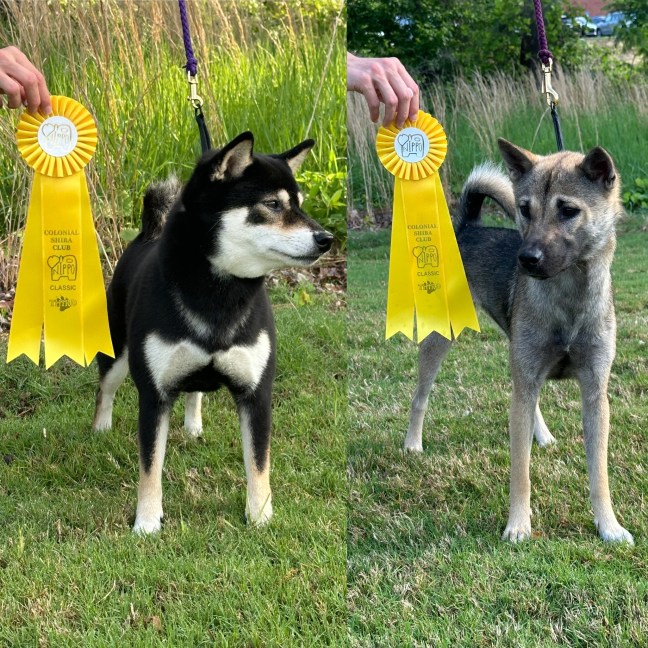
What was nice about this year’s NIPPO seminar was we received a translated copy of the judge’s notes. These notes were translated by AI (ChatGP) so there is some awkwardness with them. I am taking the time to retype the notes to make them slightly less awkward without too much deviation from the original notes; with a little bit of supplementary notes I took while the judge was discussing his notes. There are things I might have understood, which I do welcome any feedback to try to correct the information I am putting out there. I will make my supplementary notes obvious, so one does not think they are the notes we received. I will put these in italics. A reminder that the NIPPO standard is universal for all NIPPO breeds.
Thank you NIPPO judge Mr. Hidehiko Sato for coming to the states to judge our dogs and for the seminar.
Agenda
- What attracts people to Japanese breeds (nature and expression)
- The standard and current issues
- Breeding
- What attracts people to Japanese Breeds
Look at the roots of attractiveness – why are Japanese breeds so handsome?
- The balance between strength and dignity – the root of impression
- Male dogs have dignity with strength, females have dignity within strength. This phrase was coined by Sato-san’s mentor Yamamoto-san. I am understanding it as males show dignity in their physical presence/strength while females show dignity with inner strength, meaning that while they’re maybe not as physically impressive they still have a strong presence.
- Their strength comes from being a carnivorous animal, similar to a wild animal, preserved as a hunting dog. A rustic wonderful wildness, nothing fancy but still striking as this is a hunting dog.
- Dignity from the intelligence for being a working partner for humans (they’re smart animals).
- Structured as the Japanese Breed Standard. Nature, expression, and strength are part of the standard.
The assumption to understand Japanese Dog (Nihon Ken) standard
- One owns Nihon Ken and understands the breeds’ attractiveness
- This is what started the preservation of the Nihon Ken – let’s not allow this attractive animal go extinct.
Formed the Nihonken Hozonkai (NIPPO) and established breed standards
“Let’s inherit these dogs from the past and pass them on to future generations.” NIPPO started to preserve the breeds for future generations.
- Standard of the Nihon Ken and current issues
The nature and expression of the Nihon Ken are part of the standard.
- Kan’i – boldness or bravery (spirited boldness)
- Ryousei – good natured or gentle disposition
- Soboku – simplicity or naturalness
- Kankaku Eibin – sharp or keen senses
- Dousa Binshou – quick or agile movements
- Hoyou Keikai Danryoku Ari – Light and elastic gait
2.1 General appearance issues – dogs with short torsos
- The standard states that males and females should be distinguishable. Males should have a height to length ratio of 100 to 110, and females should have a slightly longer length compared to their height, with a height of 39.5 cm (15.5 inches) for males and 36.5 cm (14.37 inches) for females, allowing for a difference of 1.5cm above and below. (SHIBA) Dogs are longer than they are tall, with bitches slightly longer.
- Recently there has been an increase in female dogs with disproportionately short bodies (short torso) compared to their height. Dogs with short torsos often have restricted movement (gait). Female dogs, especially those fulfilling roles relating to pregnancy and nurturing, tend to have slightly longer body lengths compared to male dogs due to their anatomical structure. However, if a dog’s body length is insufficient, it may lack certain gender characteristics. A short torso in bitches means less puppies.

2.2 Limb structure issues
- According to the standard to the standard, the forelimbs should have a moderate slope of the scapula (shoulder blade) and well-developed muscles. The forearm should be straight and the toes should firmly grasp the ground. The feet should be tight for better gripping (cat feet) as this would assist the dog with hunting through the mountains. If the dog has flat feet (hare feet) they can’t grip the terrain as well.
- Due to the shallow angle of the scapula. A crucial component of the forelimb, the shoulders are positioned forward, resulting in a shallow chest and weak elbow joint. The elbows may turn outward or even inward, forming a narrow arch. The connection between the forelimbs becomes outward, causing the forelimbs to curve. The long and steep front pasterns further weaken the connection, and the detrimental effects of neck hanging aggravate the issue, leading to an extreme front landing stance. Pasterns should be slightly sloping. Straight pasterns or sloping pasterns are weak, therefore are undesirable. Not enough angulation in the front leads to a chest that is too narrow. Handling can make a front look ok (lifting by neck and setting down where one wants the legs to land) but once the dog stands naturally, it will return to it weak and faulted stance. Improper front angulation causes the dogs to stand learning forward.
- Dogs with weak hocks – The standard states that the hindlegs should be powerful, with strong hocks, and the toes should grip the ground firmly. The hindlegs are crucial for propelling a dog’s movement forward. Various types of hock angles are observed, including deep angles, X-shaped hocks, and straight (upright) hocks. Especially common are those resembling sickle hocks. Dogs with excessively deep hock angles significantly impact their agility and overall movement capabilities. Proper stability and secure landings in both the front and hindlimbs are desirable, allowing the dog to stand firmly as if rooted to the ground. From this perspective, limb structure should be emphasized during evaluations, and a front to rear ratio of 6:4 is preferable. Over angulated hocks creates a weak rear, a weak rear creates more grip and strength in the front which off balances the dog. Typically, a dog that has bad front structure has bad rear structure. Short hocks have been a trend, short hocks leads to weak rear structure as it impacts the hindleg structure. A weakness in structure leads to the dog compensating when standing. Correct bone structure leads to correct muscle development!
2.3 Head and neck issues
- According to the standard: “broad forehead, well developed cheeks, and a robust neck.”
- The forehead should be wide, the cheek area well developed, and the neck of moderate thickness and length. The neck should have supple, strong muscles. A single line called the vertical groove is visible in the center of the forehead, although it is shallow, it should distinct. If there are several wrinkles other than this vertical groove, it becomes a significant fault.
- Some dogs with good head development tend to exhibit a slight “apple head” shape. I did not ask for this to be clarified, but what I think is meant by this statement is the forehead is not flat nor is it so domed it creates a helmet like shape.
- Is there a connection with the body type of stocky dogs? I do not remember this question being discussed so I have nothing to answer this question. ☹
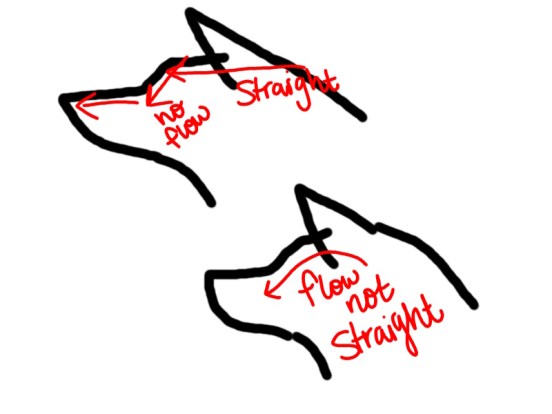
- A straight/flat forehead is undesirable. Too much of a stop is also bad, this tends to be a trend with smaller dogs though (Shiba). Steep stops do not allow a good flow on outline. A nice stop will allow for correct eye shape. Improve the skull shape to improve the eye shape.
2.4 Muzzle and lip issues
- Dogs with overlapped upper lips and thin lower jaws. The standard states: “the nasal bridge should be straight, the muzzle well developed, and the lips firm and tight. The teeth should be strong and properly aligned.”
- Particularly dogs with overlapping upper lips or when viewed from the side, shallow (thin) lower jaws (not quite duck-billed) are noticeable. The Shiba Inu’s muzzle has a significant feature – it tightens noticeably from the rich cheeks to the stop (forehead area). Since the muzzle is a central part of the face, deviations from the standard can compromise the overall facial aesthetics.
- A tongue spot in Nihon Ken are allowed but it is preferred that they do not have a tongue spot. For a Shiba, a tongue spot no more than the size of pad of your pinky finger (fingertip) is allowed. For the medium breeds (Kishu, Shikoku, Kai, and Hokkaido) the spot can be no larger the pad of your pointer/index finger (fingertip). For Akita the tongue spot can be no larger than the pad of your thumb.
2.5 Coat color and quality issues
- In Shiba Inu, black and tans with a dark glossy appearance in the color are considered undesirable. This is partly due to the coat not being in perfect condition. As a result black-coated Shiba are often exhibited in a faded black color tone. Shiny black or grey black coat is undesirable. It is becoming more common to have too much tan (creeping tan) on the legs of a black and tan. Black and tans should have a graduation from black to tan on their legs, not solid/clear borders. The extra white markings on a black and tan’s chest should have black borders, not be totally white or bleeding into the white bowtie chest marking. Black and tans have banded colored hair, goes from black to grey to buff.
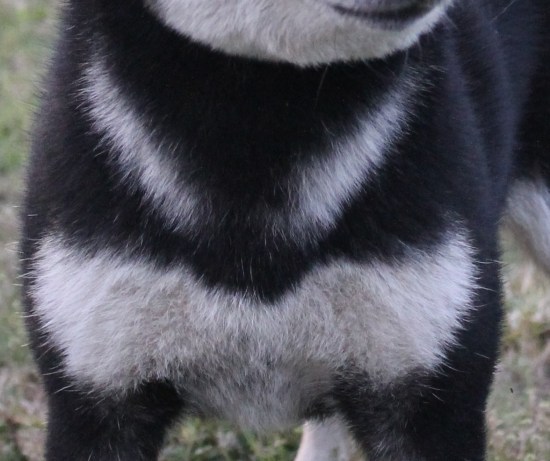
- For red coated dogs, we seek those without an extension of white fur on the face (cheeks) or the front chest. These dogs should have an overall rich red color but the intensity of the hue lacks clarity and appears somewhat dull. Red Shiba should have red on the bridge of their muzzle as well as the cheeks. The urajiro should not make the entire cheek white. White should only be on the inside of the leg, gradually the white goes to red. Clear, distinct borders are undesirable.
- Furthermore, in red-coated Shiba, if the white fur on the front chest extends, it should not reach the shoulder joint, instead it stops just before the shoulder.
- Hair is 3 banded, darkest color is at the top, followed by a medium color, to the lightest color at the root. Breeders need to pay attention to the eye dot size and the color under the eyes when breeding. Large eye dots and a lot of white under the eyes is undesirable. There has been a trend of too much white on the rear legs.
- Sesame – even distribution of black hairs on the head, body, and legs. Shiba and Shikoku sesame are different. The underside of the tail in a sesame should be light in color. Sesame also needs ticking under the eyes.
- Sashige – heavy concentrated black ticking on the back only is not good. The black ticking should be evenly distributed.
- According to the standard, Nihon Ken* should have a stiff and straight outer coat, a soft and dense undercoat, and come in colors such as sesame, red, black (black and tan), brindle, and white (cream for Shiba). The coat quality and color should reflect the distinctive characteristics of Japanese dogs. *the original notes said Shiba Inu but the NIPPO standard is universal so using context clues, I’m understanding Shiba Inu as Nihon Ken is this situation.
- In the 1980 resolution of the review committee, titled ‘Regarding the Arrangement of White Markings and Urajiro” (urajiro is the white markings on the underside). These markings, including facial saku (white hairs on the nasal bridge), front chest (surrounded by both shoulders), front and hind legs (socks), and the tip of the tail, are more appropriately referred to as roppaku (six white markings) rather than urajiro. These markings have a clear boundary between colored and white areas and align with the black and tan coat pattern, representing fixed markings. It is crucial not to confuse them with white spots or urajiro markings.

2.6 Tail problems
- Dogs with tails that are not significantly erect are also weak. The standard states that the tails should be “thick and strong, with a sickle or curled tail, and almost reaching to the top of the hock.
- The natural thickness of the tail is determined by the thickness of the tail vertebrae. In addition to the thickness of the vertebrae, the thickness of the tail hair (typically longer than the body hair) makes the tail appear even thicker.* It is natural for the normal thickness of the tail to be weak during the shedding season. Soft or uneven tail hair in undesirable. *I reworded what was written in the notes – the exact verbiage is this: to this is added the thickness of the longest tail hair when erect, making the tail appear even thicker.
- The tail should be in good balance with the body – thick, well erect, rising from the base of the tail, and not cramped. A well-shaped tail that is suitable for the Shiba Inu is strong and expressive to the tip and allows the tail to uncurl when working is a good tail. (The original words: allows the tail original ability when working is a good tail. Tails will drop when hunting.)
- Tail spacing – the space between the back to the tail (if curled): Shiba – golf ball, medium breeds – baseball, Akita – softball.
- High tail sets are preferred. Meaning the tail base comes straight from the back.
- On breeding
- Improvement of defects (avoid repeating defects).
- It is easy to break down a good trait, but it takes time and effort to restore it. Bred to improve, it is easy to lose a good trait through breeding and hard to breed back a lost trait.
- Emphasis on pigmentation (fundamental mucosal pigmentation). It is easy to get caught up in coat color alone, but it is important to look at the overall pigmentation – inside the mouth, lips, anus. Coat color need to have an overall balance.
- Skeletal structure – the importance of re-examining the skeletal structure of each part of the dog’s body.
- The standard is EVERYTHING. To understand the Nihon Ken you have to know the standard.
Miscellaneous information shared in the seminar:
- Judges judge from overall balance, then they go to the details of the dog and how they meet the standard. Temperament (attitude) is then judged after the detail judging. Judging the dog’s attitude allows you to see the dog’s true nature. Example: active, cheerful, or scared. After understanding the dog’s nature, the judge will nitpick based on the standard. (Not sure if it was Sato-san’s specific way of judging or is a general rule for NIPPO judges).
- Rear dewclaws are acceptable. The Kishu Ken have rear dew claws more often as it comes from hunting. Rear dewclaws apparently lead to better balance when hunting through the mountains.
 Boomlay Shiba Inu