I want to start this off by saying, no dog is perfect. All dogs have faults, but it is our responsibility as purebred preservationist/fanciers to realize and understand exactly what this statement means. Some faults are more detrimental than others. Sometimes the harshness of the faults can be an individual preference. I am extremely lucky that I was given a great start with good structure dogs and mentoring from Leslie (LeSand/Akakiyosou Shiba) when it came to understanding exactly what a good structured dog is.
Understanding your chosen breed’s standard is important. How can you preserve a living piece of history if you ignore the very blueprint of it? Specifically, for the Shiba Inu, many people love to boast how it’s a head breed. Why or really, how did a small hound/hunting dog from Japan become a head breed? How does having a good head (not meaning mentality) help a hunting dog track its quarry? Structure should be one of the most important parts of a hunting dog. The drive to hunt is obviously first and foremost, but I would think that logically, those two characteristics should go hand in hand. But just maybe don’t quote me as I’m not a hunter, I’m more of a bleeding-heart taxidermist.
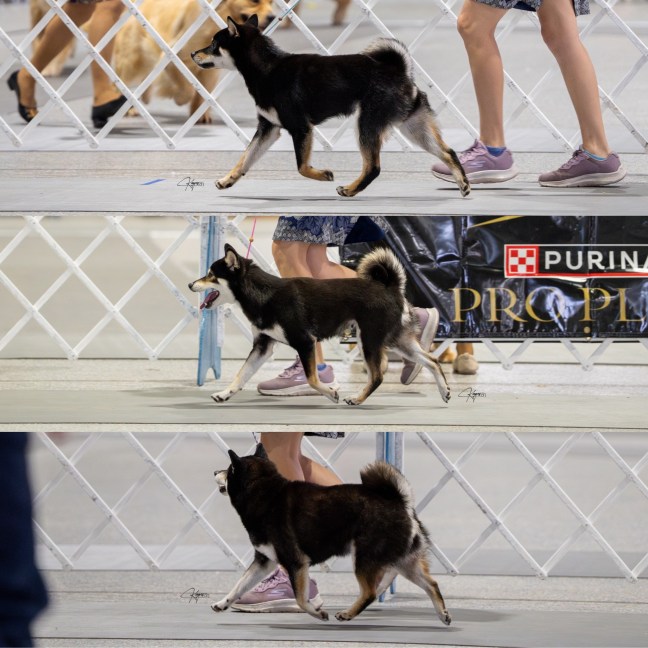
The Shiba (as well as the other Nihon Ken) are moderate dogs. Moderate in movement, in angulation, and in type. Movement is not big and flashy as that wastes energy in any terrain, much less a mountainous one. Moderation in angulation keeps movement moderate. Too much angulation can lead to wasted energy (from my understanding) while not enough angulation can lead to injury (also from my understanding).
From the AKC Shiba standard:
Forequarters: Shoulder blade and upper arm are moderately angulated and approximately equal in length… Forelegs and feet are moderately spaced, straight, and parallel.
Hindquarters: The angulation of the hindquarters is moderate and in balance with the angulation of the forequarters.
Also, that topline should be level when the dog is standing or moving – from AKC: “Topline is straight and level to the base of the tail.” “Gait: Movement is nimble, light, and elastic. At the trot, the legs angle in towards a center line while the topline remains level and firm. Forward reach and rear extension are moderate and efficient.” Not roached or swayed backed, as it seems many Shiba trend towards. A level topline comes from balanced angulation in the front and rear of the dog. Good structure is hard to get and hard to keep. Good structure also seems to be lacking due to some breeders thinking type, and only type matters. Now, some people will say well mutts can have good structure and without type how will you know what breed of dog it is? I always feel like this counter agreement comes from breeders who don’t understand the basis of balanced, good structure, have dogs with zero structure, and type is their only saving grace. Now I’m not necessarily saying type isn’t important, even though it is rather superficial (hey I don’t like ugly men or dogs, so I get it). I’m saying ignoring structure for the sake of outer beauty is damaging to a breed. Bad structure leads to pain – like arthritis, knee, hip, other joint and ligament issues down the road. Is only having a pretty face really worth it?
What is good structure? There are many wonderful books on the subject such as K-9 Structure & Terminology, An Eye For a Dog: Illustrated Guide to Judging Purebred Dogs, and What’s Your Angle: Understanding Angulation and Structure for the Performance Dog are some good examples.
But in summary, while structure varies from breed to breed, overall, good structure is balanced movement viewed from the side, front, and back. A dog should be clean moving and going, not throwing feet to the side, elbows pointing out so they’re pigeon toed, or rear feet that point in or outwards due to bad hocks. The dog’s legs on either side, typically move perpendicular without becoming a tripping hazard to the dog. Breeds typically will converge to an imaginary line down the middle, but this isn’t to be confused with crossing over or single tracking (Shiba shouldn’t single track, they do converge when they move when viewed from the front or rear.)
When viewing balanced movement from the side, a dog’s front legs and rear legs should create an equilateral triangle in the front half and the back half. A line can be drawn from the front foot off the ground, to the rear foot off the ground and it should be a straight line. Dogs should reach from their shoulder, not their elbow. Reaching from the elbow creates restricted, choppy movement. Which you guessed it – leads to wasted energy.
Overreaching in the front or too much drive (rear kick) are also energy wasters and should not be bred for or awarded. When rear angulation is too great, the drive of the dog does not match the reach leading to a unlevel topline. It does not great the picture of harmony or efficient movement which was critical in a hunting dog.
Short backs (dogs that are square) run into another issue, while their front and rear angles can be balanced, there might not be enough space and the paws cross over, leading to potential off gaits as the dog compensates to move efficiently and not trip itself up. Shiba dogs are longer than they are tall, with bitches being slightly longer. So, this is another example of needing to know your breed standard, as a square Shiba is another type of structural fault.

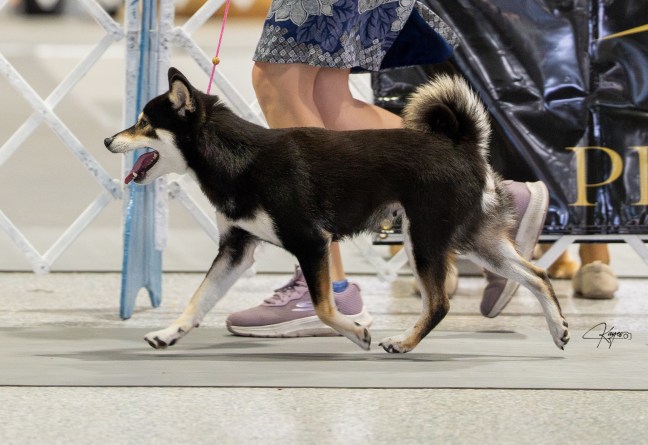

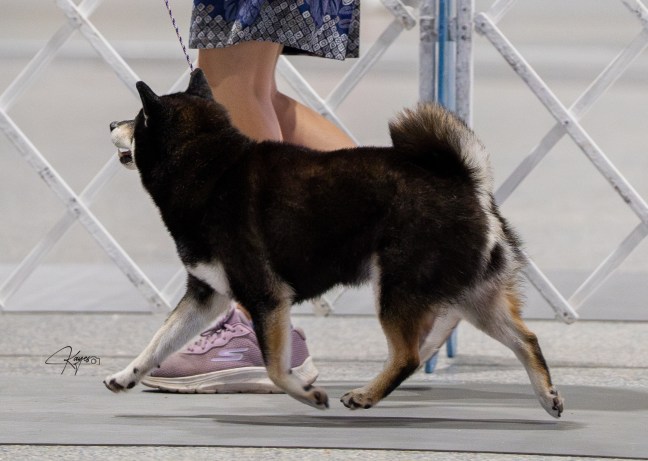


It is no easy feat trying to balance temperament, type, structure, hell, I’ll even throw in drive into the mix, with unfortunately, in my humble opinion, structure being one the last things considered. Judges, breeders, exhibitors, and enthusiasts need to be aware of the consequences of ignoring something like structure in their breeding program. Flashy, exaggerated, energy wasting movement should be a no go, just as small, tiny steps are also useless in the grand scheme of a hunting dog traversing the mountains of Japan. Honor what the breed was originally developed for. Understand structure and drive were the very basis of the Shiba Inu, not to mention correct bone structure leads to a more comfortable existence (think less arthritis, knee, hip, and elbow issues while the dog is young). Being aware of your dog’s structural faults isn’t a negative thing. Understanding what improvements are needed in your breeding program is the first step in responsibly promoting and preserving our amazing breed as it was intended it be.
 Boomlay Shiba Inu