I want to start this off by saying, no dog is perfect. All dogs have faults, but it is our responsibility as purebred preservationist/fanciers to realize and understand exactly what this statement means. Some faults are more detrimental than others. Sometimes the harshness of the faults can be an individual preference. I am extremely lucky that I was given a great start with good structure dogs and mentoring from Leslie (LeSand/Akakiyosou Shiba) when it came to understanding exactly what a good structured dog is.
Understanding your chosen breed’s standard is important. How can you preserve a living piece of history if you ignore the very blueprint of it? Specifically, for the Shiba Inu, many people love to boast how it’s a head breed. Why or really, how did a small hound/hunting dog from Japan become a head breed? How does having a good head (not meaning mentality) help a hunting dog track its quarry? Structure should be one of the most important parts of a hunting dog. The drive to hunt is obviously first and foremost, but I would think that logically, those two characteristics should go hand in hand. But just maybe don’t quote me as I’m not a hunter, I’m more of a bleeding-heart taxidermist.
The Shiba (as well as the other Nihon Ken) are moderate dogs. Moderate in movement, in angulation, and in type. Movement is not big and flashy as that wastes energy in any terrain, much less a mountainous one. Moderation in angulation keeps movement moderate. Too much angulation can lead to wasted energy (from my understanding) while not enough angulation can lead to injury (also from my understanding).
Forequarters: Shoulder blade and upper arm are moderately angulated and approximately equal in length… Forelegs and feet are moderately spaced, straight, and parallel.
Hindquarters: The angulation of the hindquarters is moderate and in balance with the angulation of the forequarters.
Also, that topline should be level when the dog is standing or moving – from AKC: “Topline is straight and level to the base of the tail.” “Gait: Movement is nimble, light, and elastic. At the trot, the legs angle in towards a center line while the topline remains level and firm. Forward reach and rear extension are moderate and efficient.” Not roached or swayed backed, as it seems many Shiba trend towards. A level topline comes from balanced angulation in the front and rear of the dog. Good structure is hard to get and hard to keep. Good structure also seems to be lacking due to some breeders thinking type, and only type matters. Now, some people will say well mutts can have good structure and without type how will you know what breed of dog it is? I always feel like this counter agreement comes from breeders who don’t understand the basis of balanced, good structure, have dogs with zero structure, and type is their only saving grace. Now I’m not necessarily saying type isn’t important, even though it is rather superficial (hey I don’t like ugly men or dogs, so I get it). I’m saying ignoring structure for the sake of outer beauty is damaging to a breed. Bad structure leads to pain – like arthritis, knee, hip, other joint and ligament issues down the road. Is only having a pretty face really worth it?
But in summary, while structure varies from breed to breed, overall, good structure is balanced movement viewed from the side, front, and back. A dog should be clean moving and going, not throwing feet to the side, elbows pointing out so they’re pigeon toed, or rear feet that point in or outwards due to bad hocks. The dog’s legs on either side, typically move perpendicular without becoming a tripping hazard to the dog. Breeds typically will converge to an imaginary line down the middle, but this isn’t to be confused with crossing over or single tracking (Shiba shouldn’t single track, they do converge when they move when viewed from the front or rear.)
When viewing balanced movement from the side, a dog’s front legs and rear legs should create an equilateral triangle in the front half and the back half. A line can be drawn from the front foot off the ground, to the rear foot off the ground and it should be a straight line. Dogs should reach from their shoulder, not their elbow. Reaching from the elbow creates restricted, choppy movement. Which you guessed it – leads to wasted energy.
Overreaching in the front or too much drive (rear kick) are also energy wasters and should not be bred for or awarded. When rear angulation is too great, the drive of the dog does not match the reach leading to a unlevel topline. It does not great the picture of harmony or efficient movement which was critical in a hunting dog.
Short backs (dogs that are square) run into another issue, while their front and rear angles can be balanced, there might not be enough space and the paws cross over, leading to potential off gaits as the dog compensates to move efficiently and not trip itself up. Shiba dogs are longer than they are tall, with bitches being slightly longer. So, this is another example of needing to know your breed standard, as a square Shiba is another type of structural fault.
Delilah movement by Kayes Media. You can see she’s very balanced – topline level, equal, moderate reach and drive.
Photo by Kayes Media
Nekora movement by Kayes Media. For 11 years old, her movement is pretty balanced. Her front foot is higher than her rear, leading to her topline not as level as it should be. She also was very excited in the ring which can throw movement, which is why a hands on exam of structure is important.
Photo by Kayes MediaWallen movement by Kayes Media. 10 month old puppy needing more ring practice/exposure. While he’s not perfect, I’m pleased with his movement overall, as he has some more maturing to do and hopefully will improve with training and of course maturity. He’s a bit square so he will have to compensate for that. He’s clean coming and going, reach and drive is moderate.
Photo by Kayes Media
Astrid movement by Phyllis Ensley. She was 3 years old in this picture. Level topline, moderate balanced reach and drive.
Astrid out coat at almost 3 years old. Perry 2021. Photo by Phyllis Ensley
It is no easy feat trying to balance temperament, type, structure, hell, I’ll even throw in drive into the mix, with unfortunately, in my humble opinion, structure being one the last things considered. Judges, breeders, exhibitors, and enthusiasts need to be aware of the consequences of ignoring something like structure in their breeding program. Flashy, exaggerated, energy wasting movement should be a no go, just as small, tiny steps are also useless in the grand scheme of a hunting dog traversing the mountains of Japan. Honor what the breed was originally developed for. Understand structure and drive were the very basis of the Shiba Inu, not to mention correct bone structure leads to a more comfortable existence (think less arthritis, knee, hip, and elbow issues while the dog is young). Being aware of your dog’s structural faults isn’t a negative thing. Understanding what improvements are needed in your breeding program is the first step in responsibly promoting and preserving our amazing breed as it was intended it be.
What was nice about this year’s NIPPO seminar was we received a translated copy of the judge’s notes. These notes were translated by AI (ChatGP) so there is some awkwardness with them. I am taking the time to retype the notes to make them slightly less awkward without too much deviation from the original notes; with a little bit of supplementary notes I took while the judge was discussing his notes. There are things I might have understood, which I do welcome any feedback to try to correct the information I am putting out there. I will make my supplementary notes obvious, so one does not think they are the notes we received. I will put these in italics. A reminder that the NIPPO standard is universal for all NIPPO breeds.
Thank you NIPPO judge Mr. Hidehiko Sato for coming to the states to judge our dogs and for the seminar.
Agenda
What attracts people to Japanese breeds (nature and expression)
The standard and current issues
Breeding
What attracts people to Japanese Breeds
Look at the roots of attractiveness – why are Japanese breeds so handsome?
The balance between strength and dignity – the root of impression
Male dogs have dignity with strength, females have dignity within strength. This phrase was coined by Sato-san’s mentor Yamamoto-san. I am understanding it as males show dignity in their physical presence/strength while females show dignity with inner strength, meaning that while they’re maybe not as physically impressive they still have a strong presence.
Their strength comes from being a carnivorous animal, similar to a wild animal, preserved as a hunting dog. A rustic wonderful wildness, nothing fancy but still striking as this is a hunting dog.
Dignity from the intelligence for being a working partner for humans (they’re smart animals).
Structured as the Japanese Breed Standard. Nature, expression, and strength are part of the standard.
The assumption to understand Japanese Dog (Nihon Ken) standard
One owns Nihon Ken and understands the breeds’ attractiveness
This is what started the preservation of the Nihon Ken – let’s not allow this attractive animal go extinct.
Formed the Nihonken Hozonkai (NIPPO) and established breed standards
“Let’s inherit these dogs from the past and pass them on to future generations.”NIPPO started to preserve the breeds for future generations.
Standard of the Nihon Ken and current issues
The nature and expression of the Nihon Ken are part of the standard.
Kan’i – boldness or bravery (spirited boldness)
Ryousei – good natured or gentle disposition
Soboku – simplicity or naturalness
Kankaku Eibin – sharp or keen senses
Dousa Binshou – quick or agile movements
Hoyou Keikai Danryoku Ari – Light and elastic gait
2.1 General appearance issues – dogs with short torsos
The standard states that males and females should be distinguishable. Males should have a height to length ratio of 100 to 110, and females should have a slightly longer length compared to their height, with a height of 39.5 cm (15.5 inches) for males and 36.5 cm (14.37 inches) for females, allowing for a difference of 1.5cm above and below. (SHIBA) Dogs are longer than they are tall, with bitches slightly longer.
Recently there has been an increase in female dogs with disproportionately short bodies (short torso) compared to their height. Dogs with short torsos often have restricted movement (gait). Female dogs, especially those fulfilling roles relating to pregnancy and nurturing, tend to have slightly longer body lengths compared to male dogs due to their anatomical structure. However, if a dog’s body length is insufficient, it may lack certain gender characteristics. A short torso in bitches means less puppies.
2.2 Limb structure issues
According to the standard to the standard, the forelimbs should have a moderate slope of the scapula (shoulder blade) and well-developed muscles. The forearm should be straight and the toes should firmly grasp the ground. The feet should be tight for better gripping (cat feet) as this would assist the dog with hunting through the mountains. If the dog has flat feet (hare feet) they can’t grip the terrain as well.
Due to the shallow angle of the scapula. A crucial component of the forelimb, the shoulders are positioned forward, resulting in a shallow chest and weak elbow joint. The elbows may turn outward or even inward, forming a narrow arch. The connection between the forelimbs becomes outward, causing the forelimbs to curve. The long and steep front pasterns further weaken the connection, and the detrimental effects of neck hanging aggravate the issue, leading to an extreme front landing stance. Pasterns should be slightly sloping. Straight pasterns or sloping pasterns are weak, therefore are undesirable. Not enough angulation in the front leads to a chest that is too narrow. Handling can make a front look ok (lifting by neck and setting down where one wants the legs to land) but once the dog stands naturally, it will return to it weak and faulted stance. Improper front angulation causes the dogs to stand learning forward.
Dogs with weak hocks – The standard states that the hindlegs should be powerful, with strong hocks, and the toes should grip the ground firmly. The hindlegs are crucial for propelling a dog’s movement forward. Various types of hock angles are observed, including deep angles, X-shaped hocks, and straight (upright) hocks. Especially common are those resembling sickle hocks. Dogs with excessively deep hock angles significantly impact their agility and overall movement capabilities. Proper stability and secure landings in both the front and hindlimbs are desirable, allowing the dog to stand firmly as if rooted to the ground. From this perspective, limb structure should be emphasized during evaluations, and a front to rear ratio of 6:4 is preferable. Over angulated hocks creates a weak rear, a weak rear creates more grip and strength in the front which off balances the dog. Typically, a dog that has bad front structure has bad rear structure. Short hocks have been a trend, short hocks leads to weak rear structure as it impacts the hindleg structure. A weakness in structure leads to the dog compensating when standing. Correct bone structure leads to correct muscle development!
2.3 Head and neck issues
According to the standard: “broad forehead, well developed cheeks, and a robust neck.”
The forehead should be wide, the cheek area well developed, and the neck of moderate thickness and length. The neck should have supple, strong muscles. A single line called the vertical groove is visible in the center of the forehead, although it is shallow, it should distinct. If there are several wrinkles other than this vertical groove, it becomes a significant fault.
Some dogs with good head development tend to exhibit a slight “apple head” shape. I did not ask for this to be clarified, but what I think is meant by this statement is the forehead is not flat nor is it so domed it creates a helmet like shape.
Is there a connection with the body type of stocky dogs? I do not remember this question being discussed so I have nothing to answer this question. ☹
A straight/flat forehead is undesirable. Too much of a stop is also bad, this tends to be a trend with smaller dogs though (Shiba). Steep stops do not allow a good flow on outline. A nice stop will allow for correct eye shape. Improve the skull shape to improve the eye shape.
2.4 Muzzle and lip issues
Dogs with overlapped upper lips and thin lower jaws. The standard states: “the nasal bridge should be straight, the muzzle well developed, and the lips firm and tight. The teeth should be strong and properly aligned.”
Particularly dogs with overlapping upper lips or when viewed from the side, shallow (thin) lower jaws (not quite duck-billed) are noticeable. The Shiba Inu’s muzzle has a significant feature – it tightens noticeably from the rich cheeks to the stop (forehead area). Since the muzzle is a central part of the face, deviations from the standard can compromise the overall facial aesthetics.
A tongue spot in Nihon Ken are allowed but it is preferred that they do not have a tongue spot. For a Shiba, a tongue spot no more than the size of pad of your pinky finger (fingertip) is allowed. For the medium breeds (Kishu, Shikoku, Kai, and Hokkaido) the spot can be no larger the pad of your pointer/index finger (fingertip). For Akita the tongue spot can be no larger than the pad of your thumb.
2.5 Coat color and quality issues
In Shiba Inu, black and tans with a dark glossy appearance in the color are considered undesirable. This is partly due to the coat not being in perfect condition. As a result black-coated Shiba are often exhibited in a faded black color tone. Shiny black or grey black coat is undesirable. It is becoming more common to have too much tan (creeping tan) on the legs of a black and tan. Black and tans should have a graduation from black to tan on their legs, not solid/clear borders. The extra white markings on a black and tan’s chest should have black borders, not be totally white or bleeding into the white bowtie chest marking. Black and tans have banded colored hair, goes from black to grey to buff.
For red coated dogs, we seek those without an extension of white fur on the face (cheeks) or the front chest. These dogs should have an overall rich red color but the intensity of the hue lacks clarity and appears somewhat dull. Red Shiba should have red on the bridge of their muzzle as well as the cheeks. The urajiro should not make the entire cheek white. White should only be on the inside of the leg, gradually the white goes to red. Clear, distinct borders are undesirable.
Furthermore, in red-coated Shiba, if the white fur on the front chest extends, it should not reach the shoulder joint, instead it stops just before the shoulder.
Hair is 3 banded, darkest color is at the top, followed by a medium color, to the lightest color at the root. Breeders need to pay attention to the eye dot size and the color under the eyes when breeding. Large eye dots and a lot of white under the eyes is undesirable. There has been a trend of too much white on the rear legs.
Sesame – even distribution of black hairs on the head, body, and legs. Shiba and Shikoku sesame are different. The underside of the tail in a sesame should be light in color. Sesame also needs ticking under the eyes.
Sashige – heavy concentrated black ticking on the back only is not good. The black ticking should be evenly distributed.
According to the standard, Nihon Ken* should have a stiff and straight outer coat, a soft and dense undercoat, and come in colors such as sesame, red, black (black and tan), brindle, and white (cream for Shiba). The coat quality and color should reflect the distinctive characteristics of Japanese dogs. *the original notes said Shiba Inu but the NIPPO standard is universal so using context clues, I’m understanding Shiba Inu as Nihon Ken is this situation.
In the 1980 resolution of the review committee, titled ‘Regarding the Arrangement of White Markings and Urajiro” (urajiro is the white markings on the underside). These markings, including facial saku (white hairs on the nasal bridge), front chest (surrounded by both shoulders), front and hind legs (socks), and the tip of the tail, are more appropriately referred to as roppaku (six white markings) rather than urajiro. These markings have a clear boundary between colored and white areas and align with the black and tan coat pattern, representing fixed markings. It is crucial not to confuse them with white spots or urajiro markings.
2.6 Tail problems
Dogs with tails that are not significantly erect are also weak. The standard states that the tails should be “thick and strong, with a sickle or curled tail, and almost reaching to the top of the hock.
The natural thickness of the tail is determined by the thickness of the tail vertebrae. In addition to the thickness of the vertebrae, the thickness of the tail hair (typically longer than the body hair) makes the tail appear even thicker.* It is natural for the normal thickness of the tail to be weak during the shedding season. Soft or uneven tail hair in undesirable. *I reworded what was written in the notes – the exact verbiage is this: to this is added the thickness of the longest tail hair when erect, making the tail appear even thicker.
The tail should be in good balance with the body – thick, well erect, rising from the base of the tail, and not cramped. A well-shaped tail that is suitable for the Shiba Inu is strong and expressive to the tip and allows the tail to uncurl when working is a good tail. (The original words: allows the tail original ability when working is a good tail. Tails will drop when hunting.)
Tail spacing – the space between the back to the tail (if curled): Shiba – golf ball, medium breeds – baseball, Akita – softball.
High tail sets are preferred. Meaning the tail base comes straight from the back.
On breeding
Improvement of defects (avoid repeating defects).
It is easy to break down a good trait, but it takes time and effort to restore it. Bred to improve, it is easy to lose a good trait through breeding and hard to breed back a lost trait.
Emphasis on pigmentation (fundamental mucosal pigmentation). It is easy to get caught up in coat color alone, but it is important to look at the overall pigmentation – inside the mouth, lips, anus. Coat color need to have an overall balance.
Skeletal structure – the importance of re-examining the skeletal structure of each part of the dog’s body.
The standard is EVERYTHING. To understand the Nihon Ken you have to know the standard.
Miscellaneous information shared in the seminar:
Judges judge from overall balance, then they go to the details of the dog and how they meet the standard. Temperament (attitude) is then judged after the detail judging. Judging the dog’s attitude allows you to see the dog’s true nature. Example: active, cheerful, or scared. After understanding the dog’s nature, the judge will nitpick based on the standard. (Not sure if it was Sato-san’s specific way of judging or is a general rule for NIPPO judges).
Rear dewclaws are acceptable. The Kishu Ken have rear dew claws more often as it comes from hunting. Rear dewclaws apparently lead to better balance when hunting through the mountains.
I didn’t grow up in the dog world. We (as in my family) had a dog when I was younger, and I always dreamed of having multiple dogs that did different activities and were my best friends since I was eleven (I was either a really pathetic child or just a weirdo). I had no prior knowledge or experience of anything doggy besides what I read in books and imagined. At the age of 14 I felt the overwhelming desire to show dogs, as I believed the only reputable way to breed dogs was to show them first, then breed them. * I wouldn’t say I’m the smartest person out there, not even close. But I will say I thirst for the knowledge of things that I am interested in, and I get obsessive – I mean dedicated – very easily. I had to learn everything I could about the dog world through Google and good ole fashion books, as no one in my family raised, showed, or bred dogs. Everyone was very into mixed breeds and not buying dogs as there’s more than enough needing homes.
But I digress, when the show dog bug bit me it was in 2007 where the motto was very much ‘breed to improve/better the breed’. I went along with it; I mean nothing is perfect and anything can stand some improvement, ne? But the thought process shifted within the last, I’d say 5ish years. The new mantra was ‘preservation breeder’.
I mean, I’m no English scholar, but those sound rather contradictory to my hillbilly** self. Did we, as a collective whole, improve the breeds to the uttermost perfection in 12 years? Or did we realize there were no ‘real’ improvements to make?
I can see wanting to breed to improve health, especially in a breed that has many health issues (this statement is a general one and not about Shiba). You wouldn’t want to preserve life threatening issues in the name of the breed I would think (again, what do I know?). Breeding for improved temperament is also something I typically don’t have a problem with.*** And I think to an extent it needs to be done. I also support breeding to improve structure that allows the dog to, well dog, but when is it too much of a “good” thing? I personally believe breeding for type as an improvement runs into creating a breed that no longer resembles the breed it was intended to be and promotes hyper types that have no form or function except for being pleasing to the eye (beauty is in the eye of the beholder). Yes, we want all of our dogs to look nice, but give me a dog that can do its job or go hiking for 5 hours, still want to keep going and not break down over a cute little shell of a dog. I can breed a homely dog with good work ethic to a nice-looking dog to get nice dogs with a good work ethic.**** But you can’t breed pretty to pretty with 0 drive and expect a dog to be able to perform.
But preserving the breed as it was originally meant to be, while noble, seemed to have turned into an almost egotistical motive (hell, improving the breed is also egotistical as well). Preserving the breed should be about making sure a piece of history is able to out survive you for future generations to enjoy and embrace the cultural significance the breed bears. We shouldn’t be breeding to improve unless it directly correlates with providing the breed a better quality of life.
Then this is where things get hairy, there are some slight improvements that need to be made per individual dog, as no living organism is perfect, but typically as a whole does the breed need it? You might want to improve a dog’s front assembly so it moves more efficiently and can go hiking for 5 hours or be able to chase prey with better endurance. So, you plan a breeding with the hopes of improving that dog, or maybe in essence, that line to make a more ‘functional’ dog. Is it improving the breed overall?
Some might say, well yes Alexis, that is improving the breed as you fixed the problem in this new dog and this new dog will contribute to the gene pool. But how much will it contribute to the gene pool? If a dog, potentially more than a bitch, but is that individual dog really going to make that much of a difference? Will it be paired up with others that compliment and promote that improvement, affecting more than just a line?
With that train of thought, every time there is a deviation of the standard of said breed and that dog is being bred, is it ruining the breed as a whole or just damning that new dog/line? We dog people all know what happens with popular sire syndrome, there’s good and bad. From personal opinion I’ve seen breeders talk about improving their chosen breed. They have a picture in their mind of what is perfect, which honestly is understandable as standards are open to interpretation and I have found out that many people’s reading comprehension level isn’t where its suppose***** to be and opinions on what are moderate angles seem to differ between individuals, thus making an individual’s ideal/perfect dog differ from the other breeder – which leads to a lot of confusion. But what I find frustrating is the talk of preserving the breed as it was intended with no back up to said claim. Either the dogs don’t have the drive or they do not look like what the country of origin promotes. Last time I checked the Shiba does not belong to me, I did not write the standard. The Nihon Ken Hozonkai (NIPPO) did. What gives me the right to deviate from the standard they composed in order to preserve the native Japanese dogs in their truest form?
My goal, as a breeder (even though I have taken a huge step back for personal reasons), is to preserve the Shiba as it was intended to be, in both looks and in drive. I’m not erasing the almost 100 years of work****** that the NIPPO did. I’m not going to disregard the Japan’s clear wishes in promoting a dog that deviates from the original breeders’ and organization’s hard work. I want future generations to enjoy the Shiba and Kishu as I have, to understand the uniqueness of the breeds, and not turn them into generic dogs. I want to keep this living piece of history alive and functioning as long as I can. Is it egotistical? Maybe, but I feel like I’m doing this out of love and a fear of Japan losing some part of its cultural heritage.
Delilah & Tsubaki playing. May 2022
*Oh my, how that has changed, but again, a topic for another time.
** I’m totally not a hillbilly, as I am not from a mountainous backwoods region. Plus, as it was pointed out my accent is a “store brand fabricated twang”.
*** When I say breeding to improve or better a temperament, I’m talking about creating stable temperaments as a majority of puppies will go to pet owners who may not have the means to handle a difficult dog. It is our duty as responsible breeders to produce sound dogs that will be able to live safely with their owner and in society. Do not agree with watering down temperaments to where anyone can own a dog, as you lose that uniqueness of the breed and just have a generic dog wearing said breed clothing. Unfortunately, it is a very fine line and very few people understand it, it seems. There needs to be a happy medium. Once again, a whole other topic for a different post.
****I know that isn’t exactly how genetics work, but its more of a best case/hope for the best scenario. I would expect some drive put back into the gene pool with this kind of breeding truthfully. But I’m just a young woman with a computer and a passion for words, what can I possibly know?
***** Wow I’m sounding really mean…
****** The Shiba Inu along with the other native Nihon Ken are NOT thousands of years old. They are NOT from the Jomen period, but their ancestors were. There were no breeds, there were not standards, just landrace hunting dogs secluded by geography in different areas of Japan. You cannot have a breed without a written standard. I promise you thousands of years ago there were no written standards for the dogs. The standards of these breeds were written from 1934 – 1936, the founders of the breeders were hunting dogs from the mountains. They were designated by size, small, medium, and large, and later became refined due to the standards set forth by NIPPO.
This is an opinion piece. Basically my thoughts and musing on the subject, which is going to piss off a lot of people. This is by no means fact, just my observations and my opinions based off of these observations.
Ask any reputable preservation breeder of the Shiba Inu about the Mame Shiba and I’m sure you’ll see them cringe and blurt out that the Mame is not a real Shiba but an off-shoot bastardization of the Shiba. Think along the lines of a teacup poodle or yorkie, just a bullshit marketing term to make people shell out more money for an unhealthy dog. I admit, I despise the whole Mame Shiba thing because I see a darker side of the Mame Shiba that people may or may not realize.
Mame Shiba are gaining popularity in Japan, practically any Shiba I met during my last trip was a Mame. Some were slightly smaller than a ‘regular’ Shiba but I saw some that were legit purse dogs, which makes me wonder what they could have been crossed with as they looked more like a Shiba mix than a smaller version of Shiba. I originally thought the smaller size of the Mame was what propelled it to this insta fame. Japanese living spaces are small, especially in metropolitan areas such as Tokyo. A small dog is more appropriate for apartment living, which, I know, a Shiba is already a small dog. So, for the life of me I couldn’t understand why someone decided the Shiba needed to be smaller.
It was on my trips that finally allowed me to understand why the Mame Shiba have become “the Shiba of choice”. There’s famous Mame Shiba Instagram accounts, merchandise being sold, and lots of Mame Shiba cafes where not only are the Japanese but foreigners are being exposed to them! But before I deep dive into this theory, I want to quickly explain a Shiba first.
A Shiba is a small hunting dog from Japan. The breed can suffer from same sex aggression (SSA), resource guarding, high prey drive, and honestly just be little shits if not selected for temperament or socialized/trained.
Shiba are not and should not be a dog for everyone. I liken them to feral little coyotes*. The Shiba is a dog that is for a dedicated owner who understands breed traits and works with the dog and not against it. I hate to admit it, but the average pet owner is not equipped to deal with cunning, borderline feral** dog. They’re use to the western perspective of a dog – which is stereotypically obey because the owner says to.
But who doesn’t want a cute little dog that is almost foxy in appearance?*** The Shiba’s good looks but potentially difficult personality leads to many irresponsibly bred Shiba being purchased and then in turn dumped into rescues or shelters. But what if, hear me out, there’s a smaller, more docile version out there? They would be a novice dog owner’s dream – the looks and an easy-going temperament in an even smaller package?! They’d sell like hot cakes!
A friend of mine surprised me on my 2019 trip to Japan taking me to a Mame Shiba café. These guys were pretty dang cute, they were slightly smaller than my smallest Shiba (who is 14 inches at the shoulder) and looked pretty well proportioned, as compared to some of the Mame I’ve seen (although the structure – the way a dog’s skeleton is put together – left a lot to be desired. BUT I feel like a lot of breeders have not the slightest inkling of what good structure is). Many foreigners in my time block complained at the lack of ‘friendliness’ of the Shiba, something that if anyone looked up breed characteristics of the Shiba they would see they are aloof by nature. These Mame did a great job driving that point home. But at that time, I wasn’t really understanding the significance of the café having 10 Shiba in a small room together with no fights, all them peacefully getting along, and playing. My three Shiba get along and don’t fight, so that didn’t really stand out to me at that time.
The top is a Mame Shiba from the Cafe in Harajuku in 2019. Look at how straight the front and rear is! It is also square, Shiba are not suppose to be square. They are longer than they are tall! Bottom is Nekora in 2019, overall a much more pleasing dog to look at and only slightly taller than a Mame (14 inches at the shoulder)
This last trip I was in Japan for 88 days, so I got to experience the country in a more in-depth way than my previous 2-week adventures. Almost every Shiba I saw ‘out in the wild’ – meaning a pet person owned it and it was not at a dog show – was a Mame. Even the pet stores that sold dogs only had Mame Shiba, no ‘regular’ Shiba. These Shiba I saw on the street were chill and friendlier than I expected, which lead me to believe that they were probably well socialized. I came across a Mame Shiba account where there are multiple reels showing her getting pampered and is just so relaxed through anything her owners do to her – even clipping nails. I watch those videos with awe and slight jealousy as I know mine would not put up with half of what that Mame Shiba does. (I hate to admit, she is really cute.) Then a friend showed me a video at Mame Shiba kennel. This kennel had at least 30 Shiba just chilling in a kennel yard with each other, even with levels of high excitement, these dogs were not getting into spats (as far as I could tell from the videos). Honestly, I think I would struggle to keep 30 Shiba even keel where there are no spats, and I know of some breeders who can’t trust/run their dogs together, yet this kennel was doing it, and it seemed with ease. I watched other videos to see if it was a fluke, it wasn’t.
Which got me thinking, are Mame being selected for easier temperaments? Or is selecting for a smaller dog, inadvertently creating a friendly Shiba? I’m pretty sure I’ve read in my college Biology textbook or some other scholarly text that seemingly unrelated genes can be linked, specifically breeding for one trait leads to some other trait also being expressed as a ‘by-product’. It’s been a while so don’t quote me, I need to find a link.
But I get it, a watered-down dog makes for an easy keeper. I don’t want my Shiba to be similar to a lab or a Golden in temperament while on the flipside I don’t want a dog that requires a master’s degree in dog management to coexist with. I’ve heard breeders (in several different breeds, not just Shiba) brag about how difficult one (or more) of their dogs are. How they have to do XYZ to make it cooperate/bearable to live with. That same dog (or dogs) will most likely be used to make puppies potentially passing along its difficult temperament. Where do the puppies go? To the general public, where the majority cannot handle a ‘strong’ temperament. If a dog person struggles with this type of dog, how could the average pet owner be successful? That’s when a breeder needs to step back and assess their breeding program but that’s a rant for another day. Preservation breeders should strive for a nice middle ground, a small hunting dog that’s not going to terrorize its household but still embodies its ancestors’ spirit. Although is that only what we (preservation breeders) want, while pet owners are wanting the Labrador in Shiba clothing?
The Mame is here to stay, regardless of if we like it or not. I do fear that the Mame will surpass the Shiba in being THE Shiba in the next ten years. If that is the case then our Shiba as we know it will most likely be facing declining numbers, maybe extinction, a fate that the medium sized Nihon Ken are facing right now. Money talks, and with pet owners wanting a smaller, easier dog that resembles just the Shiba in shape, our breed is in serious trouble. I don’t know what the answer is to stop this, as I think there is no stopping it. Education only goes so far, and you can’t educate if no one is willing to listen and understand. The Nihon Ken Hozonkai aka NIPPO actively discourages Mame as it is a deviation of the Shiba Inu (as seen here), as NIPPO was created to preserve to native Japanese breeds as they originally were… but the Mame Shiba already has a registry (nail one in the coffin). I’m not even sure if breeding for generic easy temperament would be able to save the Shiba, even though that is not what I personally want. Which again leads to another discussion of should we breed dogs to fit in with how our society wants them to or do we breed with the goal of preserving the originality of said breed?
A picture I took of the Mame Shiba at the Harajuku café in 2019
*I know coyotes are wild animals and using the word feral to describe them makes no sense, but Shiba can act feral and/or like cunning little coyotes, too smart for their own good. Better now?
**Meaning wild like, not domestic animal turned into the wild to fend for itself. Don’t @ me because descriptive language is my thing, not technicalities. I have a writer’s soul, what a poor scientist I would be…
***I hate it when people say they look like little foxes, I understand the AKC standard even mentions a fox like appearance in reds but have any of y’all actually seen a fox?
A friend made me aware of an Akita Inu event/parade happening in Tokyo on 12/2 in Shibuya in honor of Hachiko’s 100th year. Ironically, I was in Shibuya for the week as I was getting a tattoo done, so the universe must have wanted me to go. I was supposed to leave that morning, but the event was to take place from 2pm – 4pm, me, knowing that if I didn’t go, I would be mad & regret my decision. I booked an extra night at the hotel – which meant checking out & then checking in to a much more expensive but nicer room. I kid you not, that room made me wish I booked it in the beginning even with the price difference!
Anyway, I got to Saturday’s event early as I was not sure what to expect. I’m glad I did as I was able to get close to the barricade to take pictures of the dogs who would be participating in the parade. It got crowded super quickly, which again I wasn’t expecting it to be packed, so I was glad I got there when I did. Unfortunately, I do not speak or understand Japanese, so I could not understand the speeches given before the parade started. But it was nice to see the Akita Inu and experience an event honoring the breed.
These are some edited pictures of the event, with this link having all the pictures I took. All the pictures are unedited except for the ones posted here (which are in the beginning of the album).
This slideshow requires JavaScript.
I wasn’t aware of an AKIHO show the next day, luckily for me it was in the morning, so I planned to leave Tokyo at 12:50 to get back to Chiba at a reasonable hour. It was supposed to start at 9am which I was planning on staying until 11 so I had plenty of time to see the dogs, catch the train back to Shinjuku, grab my luggage from the coin locker, and make it to the bus. Due to some technical difficulties the opening ceremony didn’t happen at 9 and the show started around 9:40 (cue my anxiety) but even with that little hiccup I was able to see a fair number of the dogs. I wandered unknowingly to what I assume was the adult male ring.
AKIHO shows are set up differently than NIPPO shows (which I was more familiar with). Again, this event was packed, most likely due to being tied with Hachiko’s 100th year. There was a square barricade, 6 tapes circles spaced out in this square space. Dogs were shown simultaneously in the rings, but it was near impossible to wander to get good photos of dogs in different rings due to the amount of people present. I again was lucky as I got up to the barricade to get photos of the males in front of me. I tried my best to get pictures of the other rings but due to location, people moving, and distance made it hard to do so.
Another thing that really stood out to me was the overall engagement of pet dog owners. The Akita seemed rather friendly and willing to socialize, there was a fair amount of tail wagging from pet and show dogs alike, although there was minor posturing & noise at the other Akita to remind us all that the breed isn’t just giant teddy bears. Outside of the show area there was a ton of pet people out & about with their Akita, who all seemed to love the attention from adoring strangers. Which I’ve never experienced that kind of socialization at a NIPPO show. Granted this might have been because, again, this was tied to Hachiko’s 100th year, drawing Akita owners and fanciers alike to the event. I also have no other AKIHO experience to compare this adventure to.
My time was limited which sucked, but I was happy that I was able to experience an AKIHO show as Akita were my first Nihon Ken crush. I wish I took more photos (a common occurrence for me) but here are edited photos from the event as well as a link to the whole album. All the photos except for the ones in beginning (same ones posted here) are unedited.
Part of the fun of freezing my Florida butt off in Japan, in November is to go to the NIPPO Grand National. This show is held yearly, and this is the first time I’ve been back to Japan since 2019.
Plans got weird, so I made last minute plans to crash a Shiba group in order to go. That included a 4 hour train ride from where I’m staying in Minamiboso City to Narita airport. Due to the nature of living in a rural area, I had to wake up early to make sure I got all my connecting trains to the airport. I left the house at 7am and arrived at the airport at 11am. My flight didn’t leave until 8:55 but due to the schedules, it was better to be way early. I landed at Kansai airport at 10:30pm, took a short train ride to the hotel & fell asleep after midnight (the latest I’ve stayed up since arriving). I had one day to recuperate (which I spent going to the Osaka Pokémon Center & surprise getting lost per usual). Sunday morning was an early morning, we got up at 5am & there were more trains (several hours of riding in them) as well as a taxi ride to the show site.
Luckily for me, it wasn’t too cold, but I was bundled up to the point I’m sure people were wondering why I was so bundled it. It was great seeing the dogs, meeting new people, and just visiting an area I’ve never spent time in.
I also made the journey to Wakayama as in the recent years I’ve taken a special interest in another Nihon Ken – the Kishu Ken. Wakayama is one of the 2 places deemed the birthplace of the Kishu Ken (the other being Mie) since I was in the Kansai due to the NIPPO Grand National I figured I might as well visit. I wasn’t sure if I’d find anything Kishu related as my plans were to visit Momijidani Teien garden, Wakayama castle, & Wakayama Castle Park Zoo, but indeed I did.
Wakayama’s mascot is a Kishu named Ki-Chan. There were keychains, magnets, cookies, stickers, & a shirt with Ki-Chan on it. There were also Kishu on a couple different advertisements. But the icing on the cake was Wakayama Castle Park Zoo actually had Kishu! I was looking for the castle, thinking I’d spend more time at the zoo, so I wanted to do that last, but I got to the zoo first (didn’t realize I needed to climb up the mountain for the castle). The zoo is tiny & that’s all I’m going to comment on about it. As I left from one of several entrances/exists I noticed a brochure with 2 Kishu on them. I opened it up & it said there’s a meet & greet with the Kishu at 11! It was 10:40 so I waited around to see them. I really think it’s amazing the amount of pride Japan has for its native breeds. I have yet to encounter another breed/breed group of dogs saturated in so much cultural significance.
Anyway, here are some of my favorite pictures from the Grand National – 10 out of 341! These ones were slightly edited to enhance the colors. Here is also a link to the public Facebook album.
This slideshow requires JavaScript.
Here are pictures from the Wakayama Castle Park Zoo Kishu Ken. Also an informational link about the Kishu Ken who desperately in need more fanciers as it’s an endangered breed!
This slideshow requires JavaScript.
Hopefully this post is coherent as I just got back to home base. The flight was the easy part, the 4 & ½ hours of trains, then a bus, then walking up a mountain isn’t necessarily my idea of fun but hey I did it & I didn’t get lost!
I want to preface this with these are my musings, findings, and observations. I am by no means an expert, just an enthusiast who is always learning and asking questions. My intent with this post was less about venting frustrations and more along the lines of observations and education. This post has been at least 6 months in the making, as I was trying my hardest to formulate my thoughts in a positive and constructive manner.
Black and tan Shiba have a special place in my heart – I mean just look, it is the only color I own. What drives me absolutely nuts is the overall discredit that the color gets in the conformation ring. Shiba are not a red only dog, they naturally come in 4 colors, 3 that are acceptable to show. There is no written preference for red over any of the other 2 acceptable colors (sesame and black & tan). To directly quote the AKC Shiba Inu standard “the three allowed colors given equal consideration.”
Hell, the 2014 NIPPO Grand National Prime Minister (Souridaijinsho) award winner was a black & tan male. For the 2022 NIPPO Grand National, the best male and best female Shiba were – surprise – black and tan! How is it that black and tans can and have done well in the top Japanese show (think the Super Bowl of dog shows) while in America they are practically invisible? Is it politics? Lack of good judge’s education? Or is it that red is the safe choice? I mean look at any big American show like the yearly National, regional specialties, and Royal Canin – a majority of the specials are red and most of the winners are red. Where are the black and tans? Where are the sesames?
Black and tan, as a color, does have a lot of little nuances that need to be followed. I’ve been repeatedly told that it is much easier to get a correctly colored red – bright flame orange, no black tipping, strong face color (color around eyes and to the nose), good urajiro (white markings a Shiba must have), and a bow tie pattern on the front. Side note: I have also have seen incorrectly colored reds get rewarded over nice black and tans. So I do dare say it is not a color thing but a lack of good education for the judges and possibly the judge making ‘safe’ choices.
Black and tan is not black and white. The dog still needs to have tan markings, in harmony with the pattern. The black in a black and tan is not pitch, shiny, blue black but a more matte black, and from my understanding, red tones in the coat. Black and tans should have eye dots, not eyebrows or glasses/googles of tan. Eye dots should be circular in shape, similar to if you stuck the tip of your thumb in ink and placed it on paper. To me, a lot of tan ruins the expression of the Shiba, which is a hallmark of the breed.
2 years
4 years
Astrid’s eye dot shape and color.
2 weeks
6 months
1 year
2 years
4 years
Delilah’s eye dot shape and face color. (Nekora x Zorro)
Newborn
2 weeks
2 months
7 months
1 year
Tsubaki’s eye dot shape and face color. (Astrid x Zorro)
4 years
8 years
Nekora’s eye dot shape and face color.
7 months
3 years
Hanzo’s eye dot shape and face color. (Nekora x Taka)
A correct, overall coat of the black and tan is in my humble opinion, a thing of beauty. The black and tan Shiba has an undercoat of red, grey, and/or buff. It is striking when the sun hits the coat, and you see that indeed it is not just a pitch-black dog with tan points. This is probably the hardest thing to achieve in producing a correct black and tan. It seems to be more common to have this undercoat around the neck, hindquarters, and ears. It is harder to get the obvious, even distribution of this undercoat color throughout the entire coat.
5 months
2 years. Photo by C4 Pet Photography
Astrid’s coat color
2 years. Photo by C4 Pet Photography.
Delilah’s coat color. Her coat lacks the undercoat color but she is not blue black. Her color faults is the amount of tan on her face, lack of undercoat color, and she is rather shiny.
7 months
1 year
Tsubaki’s coat color. She is a half sister to Delilah, they share the same sire. Tsubaki’s mother, Astrid is a half cousin to Nekora who is Delilah and Hanzo’s mother.
4 years
Nekora’s coat color
7 months
Hanzo’s coat color. Ironically Hanzo is from a black & tan to black & tan breeding, a taboo breeding as black & tan to black & tan is thought to produce pitch/solid black coats with tan points. My theory is black & tans with good coat color breed together will/should produce good color but in order to avoid incorrect color the following generation should be bred back to a red. In a perfect world I would love to see how many generations of great undercoat black & tan breedings it would take to produce a incorrect coat color.
Another added difficulty is the chest markings. All Shiba, regardless of color, should have bow tie pattern on their chest. It is harder to keep it a clear definite bow tie shape, and the little (for a lack of a better description) individual bars above the bow tie are not required on a black and tan (from my understanding) but seem to be preferred by Japanese fanciers. (bars similar to the first picture.)
Different chest markings on a black & tan. Top 3 have that extra white marking, while I was told is not required it seems to be preferred. Bottom 2 have no extra white markings.
From the AKC Shiba Inu standard. Parts about red or sesame only have been omitted due to the fact that this article is about Black and Tans.
Color
Coat color is as specified herein, with the three allowed colors given equal consideration. All colors are clear and intense. The undercoat is cream, buff or gray.
Urajiro (cream to white ventral color) is required in the following areas on all coat colors: on the sides of the muzzle, on the cheeks, inside the ears, on the underjaw and upper throat inside of legs, on the abdomen, around the vent and the ventral side of the tail… On blacks and sesames: commonly as a triangular mark on both sides of the forechest. White spots above the eyes permitted on all colors but not required.
Black with tan points and urajiro. Black hairs have a brownish cast, not blue. The undercoat is buff or gray. The borderline between black and tan areas is clearly defined. Tan points are located as follows: two oval spots over the eyes: on the sides of the muzzle between the black bridge of the muzzle and the white cheeks; on the outside of the forelegs from the carpus, or a little above, downward to the toes; on the outside of the hind legs down the front of the stifle broadening from hock joint to toes, but not completely eliminating black from rear of pasterns. Black penciling on toes permitted. Tan hairs may also be found on the inside of the ear and on the underside of the tail.
Instead of completely reinventing the wheel, these two resources are an excellent break down of information on judging the Shiba Inu including the nitty gritty of the black and tan color. Here is a link to the National Shiba Club of America’s judge’s education seminar. Slides 42 – 47 are about the Black and Tan color in Shiba. There is also the National Shiba Club of America’s judge study guide.
Below is a scan of an article from the Japanese Shiba Inu club of Great Britain written by Nobi Astumi. This was published in 2002. I feel this is excellent information to share, as I will not rewrite the article or claim it is my own.
My favorite picture of the girls. Once they got older, good pictures such as this one were near impossible.
I feel many people are confused when asked: what makes a dog breeder a reputable breeder? The answer varies depending on who you ask. Pet buyers, dog breeders, vets, and even rescues will often have a different response – heck it even differs by country!
This article will elaborate on my perception of what makes an individual a reputable breeder. For me, I think there are a few key points a breeder must possess in order to be labeled as a reputable breeder in my book. However, I understand some people may disagree or feel like there are other points to be added. I’m not the end all, know all when it comes to dogs, I’m an individual who values the purebred dog for what it is, and wants to see purebred dogs flourish because of reputable breeders who care about the breed and want to do right by their dogs. I hate the fact purebreds are constantly bashed about being less healthy than mixes because of high volume/uneducated breeders will use the term purebred as a huge selling point, not caring about common genetic issues in the breed, breeding any dog regardless if it shows qualities of the genetic diseases. Purebred does not equal well bred, a well bred animal is not only a joy to live with but also a healthy example of their breed.
Passing Health Testing
Personally I feel that the most important thing any dog breeder can do is get their breeding stock health tested. Taking a dog to the vet for a checkup, being told they are healthy, and being up to date on vaccines for example is not the same as being health tested. Purebred dogs have a limited gene pool so it’s extremely important that breeders do their best to preserve the genetic integrity of the breed by breeding only the healthiest dogs or selectively breeding dogs with issues to increase genetic diversity. The OFA (Orthopedic Foundation for Animals) has a list on their website of health testing specific breeds should have and pass before being bred. These tests are set by the parent club of the breed and are posted on the OFA’s website. If the breeder does not health test, or offers passing scores of their dogs, then I would stay far away from the breeder. You can browse the breeds on via this link: https://www.ofa.org/browse-by-breed
Once a Shiba (or any purebred dog) has passed all the required health testing and has a permanent form of identification (microchip or tattoo), they will receive a CHIC number, which indicates the dog’s health testing.
Some breeders may do preliminaries on their dogs. OFA hip results are recorded as permanent results only if the dog has their X rays done at two years old. So if a breeder decides to do preliminaries and the dog passes, sometimes they may not choose to get ‘official’ results. In this case, I would ask the breeder to provide you with a picture or copy of the passing preliminary papers. You can also use this search to see if the dogs have been health tested. (https://www.ofa.org/advanced-search?search=advanced)
Contracts
Reputable breeders sell their puppies on contracts. These contracts usually state the puppy must be altered if not of breeding quality, a health guarantee, and that if the purchaser is not able to keep the dog the dog shall be returned to the breeder. This is a responsible way to make sure the breeder is not adding to the shelter /rescue system with either homes that fall through or people who decide they want to breed a litter because they paid a lot of their dog or the dog is purebred. A breeder who does not offer a return clause or even spaying/neutering of companion puppies sets the dogs up for an uncertain future. If the breeder doesn’t take back a puppy and the owner decides that the dog no longer works with their busy schedule what happens to the dog? If it is lucky it might end up in a breed specific rescue. Usually they end up at a shelter, owner surrenders are usually the first to be euthanized (especially if the dog has a reported behavior issue such as biting or killing small animals) so the dog gets housed and killed in the shelter which takes up shelter resources. Or let’s say the new owners want to breed their bitch, they just sell the puppies to the first people who offers them money. There’s nothing to prevent those puppies from being bred, sent to a shelter, or becoming impulse buys. When people purchase a breed that is not well suited for them, it doesn’t usually work out in the dog’s favor.
Purpose
The breeder shouldn’t be just breeding any dog just because they can. They should have a clear purpose for producing each litter, this cuts down on the mass producing of puppies that are unwanted, become impulse buys, or end up cluttering the shelter systems.
Ask the breeder their goals for the pairing. Is it to preserve the breed? Improve a trait? Produce better hunting dogs? Or is it more along the lines of producing a litter because their bitch has a ‘great’ temperament, or they spent a lot of money on their dog’s purchase so they want to make some money back? A breeder should be to tell you their goals for their linage/dogs. If they can’t I wouldn’t classify them as a reputable breeder.
Support
Your dog’s breeder should be your number one support system. If you have a training question, food questions, behavior question, even a ‘is this poop normal?’ question, your breeder should be someone who will give you advice and support for you and the dog its entire life. If your breeder can’t give you local vet suggestions*, local trainer recommendations*, and information regarding the breed and their linage I would find someone else more knowledgeable.
*If the breeder is local to your area.
Questions – lots and lots of questions
An extremely important aspect of purchasing a dog, especially a purebred, is knowing if the breed is the right fit for you. A reputable breeder will have an inquiry form on their website for you to fill out via email. They might ask you questions such as have you ever owned said breed? How many pets do you have? Do you have any children? They ask these questions not to be nosy, but to see if you are indeed a good fit for one of their puppies. These puppies aren’t just a ticket for some extra pocket money. These are living, breathing creatures we made the choice to bring into this world. It is our responsibility to make sure we give them the best life we can. Just because you have the $1,800 I’m asking for to purchase a puppy doesn’t mean you’ll be getting one from me.
Titling
This to me is important but not as important as the 5 other points. Titling a dog shows you made the effort with training and getting your dog out there to qualify for a nice prefix or suffix to be added on to its registered name.
Titling takes time, money, and tears – no, I’m not exaggerating. Multiple titles means the dog has had more training put into it in order for it to excel. It’s not some sort of silly paper that allows the breeder or owner bragging rights. It a piece of paper validating all the hard work an individual put into the dog, making the dog the best the owner could, and proving that the animal has a reason to contribute to the gene pool.
Please remember that reputable breeders rarely make any money on their litters – between spending money on dog shows/hunting tests/performance events, health testing, stud fees, and whelping supplies we are more often in the red with each litter. Why? We spend money showing our dogs (think entry fees, hotels, and gas) to prove our dog’s worth of being bred. We spend hours researching pedigrees, trying to find the right dog to compliment our bitches – sometimes driving 16 hours to get her bred or spending $800 to fly her to him just to have the breeding not take. It isn’t about the money, it’s about keeping our breed around for the next generation to love and protect. Don’t be shocked if you have to wait a year or two for your puppy since reputable breeders tend to have a long waiting list. Expect to wait even longer if you want a specific color or sex.
Some other key points to keep in mind when vetting breeders are:
Is the breeder part of the National breed club (http://shibas.org/) and/or a regional breed specific club (http://www.shibas.org/clubs.html), or a local kennel club? These clubs usually have a set of rules that must be followed by members when it comes to breeding dogs in addition to being sponsored by two club members in good standing. It’s no easy feat to get into these clubs.
Do breeders allow potential puppy buyers to come to their home or kennel to not only visit and meet the dogs but to pick up puppies? It’s a huge red flag when a breeder doesn’t allow buyers to come on their property to meet the parents or pick up their puppies. Meeting in a Cracker Barrel parking lot to do a puppy drop off isn’t acceptable. What could the breeder’s reasoning be? Disease control? What is more acceptable is declining visitors when a litter is just whelped as the puppies are more susceptible to infectious diseases and have little to no immunity. Or even denying a home visit after the interested party has either gone to a heavy dog traffic area or visited another breeder/kennel. Once the puppies are old enough they should be thoroughly socialized with different people and potential puppy buyers to make sure it’s a good fit.
When do the puppies go home? If they’re under 8 weeks that is another red flag. Puppies should stay a minimum of 8 weeks with their littermates and mother. This teaches them canine manners and allows them to mentally mature a bit. Sending puppies off at 6 weeks old because they are weaned shouldn’t be accepted as an excuse. Its crucial puppies socialize with their mother and littermates to develop good dog skills later in life. Some breeders may even decide to hold onto puppies until they’re 12 weeks old, especially if they’re evaluating a litter for show potential.
If your heart is set on a purebred puppy, even if it’s just to be a pet, the reputable breeder is the way to go. It’s not always easy finding a reputable breeder when Googling ‘your state whatever-breed-you’re-interested-in breeders’ and you get bombarded by websites with adorable puppy pictures, maybe some fancy words, and a well put together website. It can be hard to see pass the façade of less than reputable breeders. That’s when you need to ask questions about health testing, titling, contracts, and life time support, if the of the information isn’t offered on the website. It’s your responsibility as a potential owner of the dog to do what’s best for the breed, for future generations, and the individual dog by supporting breeders who dedicate their lives to safeguard their breed of choice.
I have had the incredible honor of meeting two very special women who have service dog Shiba Inus. I’ve been fascinated with the fact they have reliably trained their Shibas to be service dogs, a breed that is often considered too stubborn to train reliably! I kindly asked both of them to answer some question I thought of to give the Shiba Inu fanciers insight into how they’ve trained their service Shibas. To keep anonymity, I’ll use their initials instead of their full names. I was also given the amazing opportunity to interview the facility owner who helped train Mira.
RW owns Mira and CH owns Chiyo
• What was the biggest training struggle you faced when preparing your Shiba to become a service dog?
CH:There were none until recently! As a puppy, Chiyo could easily ignore other dogs lunging and barking at him in public. The challenge that we are facing is now that he’s maturing, he wants to play with these other dogs. We’re training hard to teach him that he has to ignore them like boring pieces of furniture. He’s slowly getting better considering we’re fighting Mother Nature and his instincts. But I know we will get through this passing “teenage” phase with persistence and high value treats! He’s a smart boy.
RW:Honestly, the biggest struggle I faced was myself. Mira was the first dog I’ve ever owned, so I doubted my ability to raise and train her properly. Nor was I sure how to cope with certain kinds of attention from others once Mira became a full access service dog.
A little over a year prior to getting Mira, I confided in my parents that I was struggling with PTSD. I told them that my psychologist said that I should consider a service dog, and they were incredibly supportive. After looking at different breeds and options for a year, I finally met my breeder at a show. Soon after, I put down a deposit on a puppy. At this time, only my parents and my aunt (who raises Canine Companions for Independence [CCI] puppies) knew that I hoped to make Mira a service dog.
There was definitely some internal conflict before I picked her up. I looked forward to finally having something that could help me with my PTSD. At the same time, doing so would make my struggles more public once Mira and I became a service dog team. Almost no one in my life, friends or family, knew about my disability, and I didn’t want to disclose this information until Mira actually became full access.
Again, Mira would be the first dog I ever owned, so I feared ‘ruining her’ through poor training. Fortunately, I had (and still have) a good network of supportive dog people: my aunt, who raises CCI puppies; my many friends who show their dogs in conformation; and everyone at the Pawsitive Action Foundation (PAF), where I trained Mira.
Happily, Mira swept away my anxiety a few days after coming home with me. My fears faded as we bonded. Training, while time-consuming and sometimes exhausting, was incredibly rewarding for both of us. She was a really easy puppy and I was surprised at how adapting to her training schedule helped me. There have been times when my PTSD made it impossible for me to maintain a normal schedule, due to panic attacks and fear of the same. However, with the responsibility of taking care of Mira, I found that I was better able to take care of myself. This meant that I could focus on raising and training her to the best of my ability.
This was the beginning of a tremendously positive change in my life. For the past six years, I had been unable to find the strength that I needed to take care of myself for my own sake, but I was able to find it for hers.
When Mira became a full access service dog with PAF, I was faced with a new conflict. Up until this point, I had kept my struggles with PTSD private. Having a service dog is like wearing a giant neon sign saying ‘there’s something wrong with me’ in public. Mira was helping me so much, but by acknowledging how much she was helping me, it also meant I had to truly acknowledge, confront, and accept how much my trauma affected me as well. Any attention, positive or negative, was an uncomfortable reminder of this.
I began to worry that the attention brought about by having a service dog would create more stress, anxiety, and panic attacks in public than it would prevent. I am incredibly grateful that members of the PAF with their own PTSD dogs noticed and understood what I was going through. They helped guide me through these conflicting thoughts without judgment. While PTSD isn’t something that can be cured in a traditional sense, only managed, I was able to work though a lot during this transitional period, and continued to work as hard as I always had with Mira. With her help, I’ve been able to mitigate a lot of my PTSD symptoms, allowing me to find joy in things I had been unable to for years, such as shopping by myself or attending public events with large crowds. She’s allowed me to live my life without fear again.
• What company did you use to task train your Shiba? What made you decide to use that company?
CH: We used Canine Connection, a company that does all kinds of dog training, including a service dog training program. We chose them because the trainer, Chelsea, had experience with Shibas and could come to our home for lessons, which was something we needed because it made it so much easier with my disability. Once we had our initial evaluation with Chelsea and saw how she and Chiyo interacted, we knew she had a special touch with him!
RW:I trained Mira through the Pawsitive Action Foundation (PAF) led by Norma Ross. The PAF is a nonprofit organization that primarily helps veterans by providing them with highly trained assistance dogs. They also help the differently abled population. The PAF raises and trains Golden Retrievers, Labradors, Australian Shepherds, and Goldadores (all of which are health- and temperament-tested) to be placed as service dogs. Since 2008, the PAF has successfully placed 80% of the dogs from their training programs with clients in need. The remaining 20% who are not placed as fully certified assistance dogs have still gone on to serve as therapy dogs or companion animals.
I learned of the PAF through my mother, who took her rescue dog there for training, as well as one of my conformation friends who helped produce a litter of Australian Shepherds with Norma. My friend’s pick from the litter is currently a grand champion.
I contacted Norma about a month before I had even picked Mira up. I did this to see what kinds of training programs the PAF offered. At this point, I didn’t mention that I wanted to make her a service dog, I just asked about general training. Norma was incredibly excited to hear that I was getting a Shiba, and informed me she used to own Akitas, (including one from the same breeder as Mira), and that her dogs had achieved success in areas such as obedience, agility, and conformation. There was no judgment or skepticism about wanting to train a Shiba, only genuine enthusiasm, so I was completely sold on bringing Mira there.
I chose to join the PAF’s Owner Trained Program. Here, I completed Mira’s training by participating in their classes at least once a week, as well as receiving occasional private instruction with Norma. Mira and I did this until we accomplished our goals. Mira was too young (eight weeks) to start classes when I got her, but we were allowed us to sit in and observe classes for free until she was old enough to socialize. Once we began classes, Mira excelled and progressed with her obedience training quicker than I honestly anticipated. Whatever nervousness I had about training a dog was long-gone. Every week, I took what we learned in class and continued to practice and build upon it at home. I can’t begin to describe what a joy it was to literally pour blood, sweat, and tears into doing my best to raise Mira to become a mentally and emotionally sound Shiba. Our hard work since the beginning really paid off as she started to mature. The bond between us was incredible, and Mira was consistently a well-mannered dog who wanted to please. Because of how much she was already helping me, I finally built up the courage to ask Norma if she would qualify as a service dog with the PAF when she was around six months old.
Mira and I met the qualifications with the PAF, and from this point on I trained her as a PTSD service dog. There is no official service dog registration or certification under the American Disabilities Act (ADA). However, I chose the PAF because they have their own organizational requirements that an owner-trainer has to complete before their dog is considered a fully trained assistance dog. Their service dogs are held to very strict and high standards if they are to become full access. Their dogs are also highly respected in our local community. Mira was ‘in-training’ for a long time, and only became a full access PTSD service dog with the PAF after we attended public outing training classes, completed our AKC Canine Good Citizen, AKC Canine Good Citizen Advanced, AKC Urban CGC, and PAF’s Public Access Certification. Through this process we customized her training so that she would be able to help me mitigate my PTSD.
• What lead you to your decision to have a service Shiba? Where there any biases from the training company when you mentioned the breed?
CH:I decided on a Shiba because even though I had loved many breeds growing up, I had bonded very deeply with my neighbor’s Shiba Inu, Nikko, in a way that I hadn’t with any other dog before. I used to baby sit him when his owners went on vacation, and I absolutely loved his energy. I knew a Shiba was for me. Also, I knew I couldn’t handle a large breed. I needed a smaller dog, but one still tall enough to reach me for the retrieval tasks that I need. Then there’s also the fact that Shibas are a primitive breed, one that is known to be highly intelligent. I needed a dog that would be able to use its own decision making skills to help me in the event I could be unconscious. Shibas have that intelligence that separates them from the average dog. Our trainer had experience with Shibas as well, so she knew exactly what to expect from my little puppy and had no negative bias against his breed
RW:As I’m sure you can imagine, I took the question of what breed would best be best suited for me very seriously. Any breed can be a service dog, but there is a reason that Labrador Retrievers, Golden Retrievers, and crosses of the two breeds make up the majority of the service dog population in the United States. Both breeds are highly trainable, possess stable temperaments, and have the stamina to perform a wide variety of tasks in any environment (especially public areas where other breeds might tend towards being too shy or aggressive). I considered these breeds as options, but did not feel that they would fit my own personality, temperament, or lifestyle.
I continued to do research and considered my options for about a year, but deep down I think I knew that I had committed to getting a Shiba pretty early on. What attracted me the most toward the idea of a choosing a Shiba is that they are mostly a ‘one-person dog’, and they usually develop a fierce loyalty toward the person they have bonded with. It was pretty hard for me not to fall in love with the idea of an intelligent, confident but quiet, naturally clean, and athletic dog with energy levels similar to mine. One who would be loyal but not clingy once I earned their respect. Breed size was another large draw. I plan on returning to school in August to pursue a PhD, and a bigger breed simply wouldn’t be realistic with the associated lifestyle or housing. I made sure I also understood the potential negatives of owning a Shiba and prepared myself for how I would handle certain behaviors if I were to encounter them.
As mentioned earlier, I went to the PAF before I had even picked Mira up to see if I wanted to train with their organization. I was aware that there is a stigma about Shibas being ‘less trainable’ than other breeds, so I asked Norma her opinion on the subject. She did joke that problems can arise when people own dogs smarter than them, but believed that Shibas and other Inus are perfectly capable of successfully participating in any dog activity, and can excel when they have good communication and trust with their handler.
While I didn’t receive any negative bias from the PAF, I did receive plenty of (reasonable) warnings from knowledgeable friends against owing a Shiba as a first dog. I can’t imagine the reactions I would have gotten if I had told people I was getting one with the intention of making it a service dog. Fortunately, my gut instinct about my compatibility with the breed proved to be correct. I personally did not experience any major difficulties, Shiba-specific or otherwise, while raising and training Mira. She was as close to perfect as you can get with a puppy, and quickly matured into an incredible service dog. I don’t think my success with her is the result of simply getting lucky with a ‘good Shiba’. It’s because I picked the breed I knew I would connect and bond with best. This bond, combined with proper early socialization and thousands of hours of consistent professional training (which I will elaborate on below) has allowed Mira to excel in becoming the service dog I needed her to be. I also didn’t train or treat her differently than any other breed of dog at the PAF. Given how successful Mira and I are as a team, I would argue that with the right owner and training, Shibas might actually make better psychiatric service dogs than many other breeds due to how strongly bonded, trusting, and in-tune they are with their one handler.
• How does the general public react to your dog? Do you get the question “how did you train your Shiba?”
CH:Chiyo is always met with curiosity and enthusiasm from the public, whether he’s out working or just going for his morning stroll with me. I get stopped by loads of people asking me “what kind of dog is that?”, and of course “how did you get him trained?” I’m happy to answer everyone’s questions, so many people have never even heard of the breed when I tell them he’s a Shiba Inu. Even less people understand what it takes to train a service dog. It takes hundreds, if not thousands of hours for a service dog to be fully trained, which is something many people ask about him and I’m glad I’m able to educate them. Sometimes they are wondering if a service dog could be something that they need in their own lives. I feel it’s important to share Chiyo’s journey because it shows what service dogs, specifically service Shibas, can do to help people with disabilities.
RW:”Is that a fox? No? Well it looks like a fox! What kind of dog is it? Doge! SHIBA! It’s the dog from the internet!” In my personal experience the general public acts in one of two ways: curiosity about the breed or, if they’re familiar with Shibas, pure excitement.
Unfortunately, regardless of breed, a lot of people get uncontrollably excited to see dogs in public places. The most common reaction I get is simply people wanting to pet Mira. It’s up to each individual handler to decide how they want the general public to interact with their service dog. I personally don’t mind if people pet Mira as long as they ask politely first. If I agree to let someone pet Mira, I will give her the command ‘make a friend’, to let her know someone is about to approach and touch her. First, I make sure she is sitting. Then, I allow the person to approach her and pet her on the side or under her chin. I like structuring greetings with strangers because there are a lot more people than you would expect who try to run up and pet without asking.
I am very firm with telling people to stop, and that she’s working, if they’re trying to pet Mira without permission. I’m also very good at weaving her out of the way. When Mira is working in public, she is supposed to focus on me and ignore environmental distractions. However, to do that she needs to be able to trust me without worrying that anything too uncomfortable or stressful is going to happen to her, such as strangers startling her or touching her in inappropriate ways.
When Mira was still in training, she was so small that we had to use a recycled vest that originally belonged to a Labrador puppy. The only signage it had was a PAF logo. During this time, the general public was a lot more invasive. The public became less so once Mira started wearing her official full access vest. The vest displays ‘PAF PTSD Service Dog’ and her obedience titles. She is an unusual breed, and I don’t have any visible physical disabilities, so there have been members of the general public who have been accusatory and rude to me.
While a service dog is not legally required to have a vest or any signage about a person’s disability, the transparency has made everything so much easier for the both of us. I’ve found people are a lot more respectful about not trying to pet or distract Mira when she’s wearing her vest, and are significantly less disruptive overall while we’re working.
Finally, I don’t think I’ve ever been asked how I’ve trained Mira. I have, however, been stopped and told by many different individuals who are familiar with, or own Shibas, who feel the need to inform me that they’re un-trainable. I’ve learned not to let this negativity bother me and usually just smile and nod as Mira and I go about our business.
• Did your instructor have to alter any task training to fit your Shiba’s needs? (Training style, height restrictions, etc.)
CH:One thing that Chelsea did that was a customization to Chiyo’s training was teaching him his “perch” command. When Chiyo was still growing, he could retrieve items for me, but wasn’t tall enough to reach me yet. Chelsea taught him to jump up on his hind legs so that he could be tall enough to put objects in my hands. I’m on the short side and have long arms, so it was just the little boost he needed in the meantime until he grew to full size. Now that he’s an adult, he doesn’t always need to use his perch command to reach me, but it’s still a useful skill as well as a building block for other more complex tasks he now knows.
RW:At PAF, Mira was trained and held to the same standards as any other service dog in training there. We sometimes had to improvise smaller equipment for Mira since most things at PAF are sized for Labradors. The fact that she’s smaller never prevented her from participating in anything.
Mira progressed in her training around the same pace as the other dogs at PAF (and sometimes quicker), but there were a few occasions where Norma and I decided it would be best to alter her task training. Both were situations where we had to break down certain commands into more steps than another dog, such as a Labrador, might need. This was because Mira would sometimes over-think things. When we were working on recall, she was excellent at responding to ‘come’ unless I told her to ‘stay’ first. She was very proud of her ‘stay’ and would not budge even if I tried to call her over after. To help clear up the confusion between the two commands for her, I had to break up the command into ‘wait’ (a temporary stay where she is supposed to respond to commands after) and ‘stay’ (where she does not move at all).
The second time I had to break up commands was during retrieval training. For Mira, this was probably the task that took her the longest to learn. First, I had to teach her to target the color yellow (what I use for anything I want retrieved because it’s highly visible to dogs yellow-blue dichromatic color perception) and how to ‘hold’ objects in her mouth. Then I had to teach her she could move around while holding objects, something she seemed personally reluctant to do. Finally, I taught her how to pick up objects marked with yellow and bring them to me. I had to rework how I approached certain tasks a few times. However, once things click for Mira, she is incredibly consistent and happy to do her job in any environment.
• What was your Shiba’s motivation to work for you? How did you wean out treats?
CH:Chiyo naturally has a very high work drive, and he is extremely food motivated. I discovered this the day I brought him home at 8 weeks old. I made him do simple commands for spoonfuls of wet food, and I was so surprised that he came already knowing how to “sit.” Right then I knew I had a special one. He loves to work, craves mental stimulation, and constantly wants to learn more. I get tired before he does in our training sessions! But we don’t have to wean out treats, just like you wouldn’t wean an employee off pay checks. Though there are tasks he does perform without expecting compensation, rewards keep him interested and I believe in a fair trade. Chiyo will happily train all day long, especially when there’s something tasty to be earned. To him, working is his favorite game, and he always wins.
RW:Mira’s motivation to work for me ultimately comes down to the way I raised her and structured our relationship (and continue to do so) from the day I brought her home. I’ve always hand-fed her, and I believe this is critical. Hand-feeding established a very clear power dynamic between the two of us very early on. If Mira every needs anything, especially food or toys, she has to work for it. I’ve never let her run off with either to enjoy on her own terms. Of course, I make sure that this relationship is fun for her, with lots of positive reinforcement and praise. She’s definitely a dog that enjoys to solve problems and think things through in her own way. I’m convinced one of the reasons she’s done so well in obedience is because the way I’ve trained her leads her to believe that the behavior I require of her is her own idea.
I also made sure early on to teach her that I’m the most fun and interesting thing to be around. When she was a puppy until around six months old, our obedience training would be in very short segments multiple times a day. When we weren’t training, I would tie her on a six-foot lead clipped to my waist. This allowed her to be a puppy, while also teaching her that her place was to always be near me. I’ve heard Shibas are known for their cat-like independence at times, but the way I raised her never allowed Mira to be that aloof. I used the time we weren’t training for socialization. CCI has a fantastic socialization timeline for what potential service dog puppies should be exposed to, based on their age. At PAF and at home, I made sure I properly exposed Mira to as many sights, smells, sounds, trusted people and dogs in as enjoyable of a manner as I could.
I’ve never had a problem with Mira being willfully disobedient, stubborn, or destructive. If she engaged in behavior I didn’t want, I would correct her by firmly telling her ‘no’ and showing her what I expected of her instead. If she listened, she would be rewarded, if she didn’t, I would crate and ignore her. I would come back and repeat until she understood the correct behavior I wanted from her. This never took very long, as Mira did not enjoy being ignored and not receiving any attention. The crate was boring, spending time with me was fun.
Once she was around six months old and understood all her basics, I began to wean her off treat rewards. I began by making treats rewards random. For example, if I asked her to sit, instead of rewarding her every single time, she would get one treat for every three successful attempts. Mira responded really well to randomization. She didn’t seem to get frustrated and I think it became a fun mental game for her. Soon, I was able to spread out treat rewards even further, and today she consistently listens without any treats, just praise. Spending so much time and effort teaching Mira to explore the world with manners and confidence created trust and a special bond between us. Ultimately, this bond is why Mira is motivated to work for me and has lead to where we are today. Treats, praise, and consistently firm but fair training simply laid the foundation.
• Was there any specific method you used or the breeder used for picking a Shiba for you? (Genetics, temperament, etc.)
CH:I didn’t know it, but I was given pick of the litter. His breeder jokes with me about how she wishes she had kept him for herself! Chiyo was specially picked for me when I explained to the breeder what I was looking for and that the puppy was to go into training to become my service dog. I stressed the importance of a calm temperament and the smarts needed for the demanding job the baby would fill. She seemed pretty skeptical at the idea of a working Shiba, but said I could certainly try with the right puppy. And the right puppy he was indeed. When I asked the breeder what made her pick this baby for me out of all the others, she said he was the most “personable”, and that she could tell even at those stages of infancy that he was different than any other puppy she ever had.
RW:When I put down my deposit with the breeder, I made it very clear that I would prefer a girl. I also wanted the most even-tempered puppy in the litter. My breeder was very honest with me about what was available when some litters were born, and they selected a puppy for me based on my preferences. I don’t know if there was any specific method they used to pick a puppy, but I highly respect them for doing their best to meet my needs. Everything was very transparent, I was able to meet Mira’s parents and see how she was raised before coming home with me. I do believe the way Mira was raised with her breeder as a puppy has contributed to her mental soundness as an adult.
• What do you feel makes a dog service dog material?
CH:There are so many important qualities that go into the making of a service animal, and in my experience, among the most important is the dog’s temperament. Besides willingness, a dog in training needs to be able to keep calm and focused in any and all situations. Loud crashes and bangs, large crowds, long hours, food everywhere, and people of all ages trying to grab at you because you’re a cute dog out of context are just some of the things you’ll need to tolerate if you’re a prospective working animal. Many dogs can be taught to fetch, but not many can be taught to like living their lives in public. That’s why desensitization is vital when beginning with a puppy, and it’s a lot easier when that puppy has the right temperament as a foundation.
Next to that, I’d say trainability. You need a dog that enjoys the work, can pick up quickly, and that wants to learn. When you find what motivates your dog, there’s no limit to what you can accomplish. Chiyo still surprises me every day, and it’s just a joy to work with him. You can see how much he adores his job, it gives him such a sense of purpose, and he knows how needed and appreciated he is. I thank him every day for his service.
RW:According to the ADA a service dog is defined as:
”… any dog that is individually trained to do work or perform tasks for the benefit of an individual with a disability, including a physical, sensory, psychiatric, intellectual, or other mental disability. The work or tasks performed by a service animal must be directly related to the handler’s disability. Examples of such work or tasks include guiding people who are blind, alerting people who are deaf, pulling a wheelchair, alerting and protecting a person who is having a seizure, reminding a person with mental illness to take prescribed medications, calming a person with Post Traumatic Stress Disorder (PTSD) during an anxiety attack, or performing other duties. Service animals are working animals, not pets. The work or task a dog has been trained to provide must be directly related to the person’s disability. Dogs whose sole function is to provide comfort or emotional support do not qualify as service animals under the ADA.”
Under the ADA, State and local governments, businesses, and nonprofit organizations that serve the public must generally allow service animals to accompany people with disabilities in all areas of a facility that is open to the public.
The best service dogs are those with an even temperament, who are able to perform specific commands, and provide calm, reliable assistance after receiving years of expert training. I do not believe a dog should qualify as a service dog if they are: overly friendly or fearful; easily stressed out by crowded places; inappropriately reactive to other dogs; or cannot be controlled by their handler and consistently behave in unacceptable ways such as barking, having accidents, eating food, or disturbing other people. As I stated previously, it is undeniable that there are certain breeds such as Labrador Retrievers, Golden Retrievers, and crosses of the two that naturally excel at service dog work compared to others. However, any breed is capable of becoming a service dog if they are able to meet the rigorous standards to which a service dog must be held, as Mira and I love demonstrating.
While this is another topic in its own right, it is clear that across the country, more and more people are taking advantage of the ADA in order to have the convenience of taking their pets out shopping, to local businesses and to restaurants. Many people with disabilities who use service dogs have faced increased discrimination from businesses owners and other patrons, due to prior bad experiences with fraudulent service dogs. It is extremely frustrating to learn about people taking advantage of the ADA and passing off their pets as fraudulent service dogs. I don’t think there is a clear solution to this complicated and nuanced dilemma. However, I would strongly support better legislation that makes misrepresenting an assistance dog a punishable offense, as well as requiring proof of basic obedience training such as minimally acquiring a CGC before allowing a dog to become full access. The best I can do is to lead by example when Mira and I are working. Every time I go out in public, my goals are to show what standards a legitimate service dog is held to, and to demonstrate how a highly skilled service dog can enhance a disabled individual’s independence.
• Do you have an advice for people who want to task train their Shibas?
CH:I meet lots of owners who want to know how to get started with task training their Shibas! I’ve been able to help many families online by giving training advice and making little tutorial videos with Chiyo demonstrating how to teach new commands- from retrieving medications to getting your dog to use a litter box. For those who are just starting out I tell them first it’s helpful to have a private trainer do an evaluation to see if their dog has the right capabilities to suit the needs of the handler. Decide if you want to have a professional to help you with training, or if you’re experienced in dog training already, you can go the route of owner training. Next is to find out what motivates their dog. It could be a toy, it could be food, it could be scratches behind the ear, or even praise. Once you know what dogs want, you can get them to do something you want. With patience, repetition, and lots of love behind everything you do, you’ll be on your way to a beautiful relationship with your Shiba. The deep bond between a service Shiba and their handler is unlike any other.
RW:I’m obviously not an expert dog trainer, and I can only speak from my personal experiences. Just like people, dogs are individuals, so what worked for Mira and I might not work for someone else. At the same time, if I had to give advice, I would say: don’t ask how to task train your Shiba. Instead, ask how to task train your dog. Mira happens to be a Shiba, but I’ve trained her with the same mentality I would have had with any other breed, as elaborated on in my previous responses. My other piece of advice for anyone wanting to task train their dog would be to set up a good foundation by hand-feeding them (yes, it is incredibly time-consuming and they may go on a hunger strike in the beginning if used to eating from a bowl, but it’s worth it). If you have your dogs focus while task training, and make it fun for them (while at the same time being firm, consistent, and patient) it should lead to success. Most importantly, if you’re having fun through the process and give your dog your heart, they will return that love tenfold by bonding with and trying to please you. Especially if your dog is a Shiba.
Training facility interview
I was able to interview Norma, the facility owner of the Pawsitve Action Foundation (pawsitiveaction.org). This foundation helps meet the needs of veterans and people in need of service dogs. Norma breeds and trains her own dogs, providing lifetime support to both the dogs and their owners. Norma pays special attention to her client’s needs and engages them throughout the training process. She provides clients with the ability to learn valuable handling and training skills, ensuring a successful relationship between dog and owner. Since 2008, PAF has successfully placed 80% of their dogs with clients in need.
One question I asked Norma was how much did she have to alter her training program to accommodate a Shiba? She explained she didn’t alter much. Her service dog training program was developed after years of working with multiple dog breeds, resulting in the ability to reliably train a variety of dogs with a variety of different personalities. With primitive breeds, such as Shibas, she strongly suggests starting training as early as possible.
Norma then leapt into some specific Shiba training advice for that works well for primitive dogs and, in this specific case Mira. A suggestion she offered, is having people teach their puppies to play more with toys, as it will help as a reward during training. Some dogs who aren’t taught toy drive will look at you like “you threw it, you go get it”! Working one on one with a puppy when they’re young will help create toy drive. Cat toys are a good start towards making a puppy more accepting of play, which in turn helps with creating motivation. Another suggestion given was playing ‘find it’ games. Hiding something then having the dog search for the hidden item helps engage the dog, helping prevent a split in human-dog interaction often seen in more primitive dogs.
All dogs are domesticated animals. However certain breeds, such as Labradors and Golden Retrievers, are more domesticated than others. The more heavily domesticated a breed is, the more juvenile puppy behavior they retain even as adults. Primitive breeds such as Shiba Inus grow more out of their juvenile stage and develop more adult dog behavior (resulting in a greater capacity for independent thinking). A goal for successful training therefore is to create a dependency (a puppy behavior) with these breeds, rather than foster independence.
One way to create this dependency is by hand feeding; this is not withholding food but rather making the dog work in order to be fed. Start with eye contact. Dogs who make eye contact will be fed. After this step, encourage the dog to move towards to you and give eye contact for food. Ultimately, this eye contact is teaching and retaining begging, a puppy behavior. Some dogs may offer eye contact reliably because they’re more ‘puppy-ish’, while more mature dogs will struggle because it is a perceived as a threat. But as owners, we need to train reliable eye contact for successful communication. Meaning we have to teach and reinforce begging and other puppy-ish behaviors to create dependency. After the basics, educational games allow the dog to interact and engage the owner, which is extremely important when training a Shiba to be a service dog. Mindless wandering creates independence!
With primitive breeds, focus on just a few repetitions at a time, or they’ll quickly get bored. During training you’ll want to have one good progression, then pause and give the dog a break. If you keep repeating the same thing over and over, the dog will become frustrated as they’ll wonder what they did wrong and why they aren’t able to progress.
In order to be successful while training a Shiba, it’s important to remember what the breed was originally bred to do.
It is well know Shibas were bred to hunt. They had to be smart and quick to survive their hunting adventures. They also didn’t have a lot of human direction when loose in the mountains, so independent thinking was required of the breed. This independent streak has been known to lead to training troubles, because Shibas question commands. You can’t fight with them, so a handler has to convince them that it was their idea to carry out a command. Let them to problem solve, if they do, they get. Allow them control the outcome of the exercise by complying, because in their mind, they’re controlling the situation. “If I sit, I get.” “If I heel, I get.”
For greater success, it helps to breakdown training to tiny pieces. Treat training like building blocks. Because Shibas are a naturally suspicious breed, you have to show them each advancement in the training is not so different, maybe just a tad but not enough where they wonder what’s going on or get frustrated with the change. Owners tend to get upset with the dog instead of properly evaluating the situation, resorting to the conclusion of “Oh they’re so stubborn.”
After sharing this insight, I asked Norma what the biggest struggle she faces with training (service dog or not) has been. She explained it isn’t finding the right motivation to get a dog to work with their handler, but rather the frustrating reality that some people aren’t willing to listen. They want to do everything their way, often with no experience, instead of finding a good instructor they can take their dog weekly or bi-weekly to. They allow the dog too much freedom, resulting in the unfortunately common situation of thinking their dog isn’t causing any problems until the dog reacts drastically in a situation it’s never been properly trained to handle (such as biting a strange guest in the house). People need to accept, understand, and respect their chosen breed. A Shiba is not, and will never behave in the same manner as a Lab, so a handler must work with the dog they chose in the most appropriate way with that breed.
The last question I asked Norma was what does she feel makes a dog service dog material? She stated she believes any breed is capable of becoming a service dog if they’re able to reliably provide specific care for their owners. She emphasized that genetics do play a significant role in determining behavior, and preferably one should go to a breeder who knows their bloodlines as well as what temperaments they produce. Norma considered low reactivity one of the most important behavioral traits when selecting a service dog prospect. A program she suggested using as a guideline was Sue Sternberg’s Asses-a-pet program (http://www.suesternberg.com/rvaa/assess_pet), which helps predict sociability and aggression in dogs.
I would like to give a huge thank you to Norma of Pawsitive Action, RW and CH for taking the time to answer my questions and giving me and the readers a little insight on services Shibas and the training they received.
Baron and Shigeru after successfully taking a 60kg (132.3lbs) male boar. This is probably the most dangerous size of boar due to their razor sharp tusks, the boar’s speed and mobility.
Shigeru Kato is an important member of the Nihon Ken community. He helps with the exportation of Japanese dogs to breeders not located in Japan. He has a website dedicated to promoting and preserving the six native Japanese dog breeds (JapanDogExport.com). He also has a an informational blog that includes subjects such as registration numbers in the Nihon Ken, available dogs for export, and hunting news/information (The Nihon Ken Blog).
Since I knew Shigeru was an avid hunter I asked him a couple of questions in regard to hunting with Nihon Ken and he generously allowed me to share a blog post he wrote about hunting with Nihon Ken.
1. What made you decide to start hunting with Nihonken? Were you a hunter before you started using dogs? What’s the difference between using dogs for hunting versus hunting solo?
Other than my first season as a hunter (when my first dog was still a pup), I’ve always hunted with dogs. I started hunting to begin with because I wanted to get away from eating factory farmed meat. With the increasing number of boar and deer in Japan, an aging population of hunters, and widespread crop damage, hunting was the no brainer alternative.
I’ve always loved sneaking around watching wild animals, I used to do a lot of stalking just for fun, so the first hunting season was pretty much just an extension of that, only I was carrying a shotgun now. Here in Japan if you’re going to hunt wild boar and be successful at it, you need to use dogs or you’ll never see them. They’re generally nocturnal over here, and we’re only allowed to hunt from sun up to sun down.
I’ve always loved dogs, so getting to choose a breed was a lot of fun. In the end it came down to a simple idea that the hunting breeds that had evolved for thousands of years here in Japan were probably best suited to the game and terrain.
I can’t really speak to the difference between hunting with or without dogs. What I will say is that hunting with your own dogs is an amazing adventure, and once things start to click and you’re hunting as a real team it’s quite a magical experience.
2. How do you train Nihonken for hunting?
Being a primitive hunting breed, hunting is mostly instinctual. A pup has it bred into it, or it doesn’t. More than actual training to hunt, I work on the important things to be able to hunt safely with them. You obviously want a dog that has some semblance of a recall, is socialized and not going to be aggressive toward strangers (and hopefully not toward strange dogs either, but that’s a bit more difficult with the Nihon Ken), and will hunt fairly close to you. I’m basically going through simple obedience training with pups from when they’re 2 months old, socializing them a lot, getting them used to the smells of the game we’ll be hunting, playing and walking off leash a lot, and as they get older, learning how to move around obstacles in the mountains.
As they get from 8 months to a year old, I’ll introduce them to a live boar. Since we trap nuisance animals in the neighborhood (around 70 this past fiscal year), that’s often their first experience is to see a boar in a box trap. I want the dog to be aware of the boar, wary at first, and then hopefully to vocalize a bit (but that’s not a deal breaker for the first time). If a dog gets it right away and is moving around the boar with a lot of barking, the next experience will be to take them to a facility that has boar in a large pen. Here I want to imprint on the dog that boar is definitely what we’re after, and that they are dangerous, so be careful.
Once I’ve gotten to this point, it’s just about getting out in the mountains with them a lot. Experience is the best teacher, and it’s all about repetition.
3. What in your opinion makes a good hunting dog? What do you look for when selecting a hunting dog?
There’s a term in the Nihon Ken standard, ‘Ryo-sei’. I translate it to mean a dog with a good balanced temperament. I think a dog with ryo-sei makes a great hunting companion and a great pet as well. A good hunting dog is going to help you bring back meat for the table, is going to stay out of the way of injury, and help you hunt safely (that means you and other people/dogs you meet). This dog will switch it on in the mountains, but is just as comfortable switching off back at home and curling up by the fire.
When selecting a dog for hunting, I’m looking for a curious, even tempered dog that bounces back from surprising noises quickly (but is not oblivious to them). Obviously I need a curious dog that has some drive to hunt. An even tempered dog will be a joy to own, and if the dog doesn’t work out as a hunter, finding a new home will be easy. Bouncing back from negative experiences quickly is important when hunting boar, since they are dangerous game, charge a lot, and put a lot of pressure on the dogs.
4. What was/is your most memorable experience you had hunting with your dogs?
I’m not sure if they are the most memorable because they were special, or because my memory is fading, but there were two hunts from this last season that come to mind. The first was the most perfect and clean boar hunt I’ve been on bar none. I had my two Kishu with me, Baron and his daughter Karen, and within 5 minutes we were dragging out a 125kg boar. The dogs had picked up the scent immediately after we left the car, I took the high ground, and they had this mountain of a boar locked down right where he had been sleeping in thick bamboo cover. The dogs were baying and tustling together as a perfect team, I slipped in and one head shot later the boar was down.
The other hunt was a month or so later. Baron got very seriously injured this season when we were jumped by a large group of monkeys, so I had to start hunting the younger dogs more. Without much expectation I took Karen and Rin (young Shikoku female) out together as a pack, and that first day was shocking. They got on a boar right away, it got away, but 20 minutes later they were on another, and the day kept going like that. They were growing by leaps and bounds as a little hunting pack right before my eyes, and I was so proud of them. To see the dog’s genetics come through in dogs you produce is amazing.
5. Do you have any words of wisdom in regards to owners wanting to hunt with their Nihonken or why keeping the hunting “spirit”/prey drive is important for the Nihonken?
Well to borrow the words of an old NIPPO judge, a Nihon Ken that doesn’t hunt is not a true Nihon Ken. They’re a working breed, and since our goal here in Japan is preservation, that means preservation of not just the ‘look’ of the breed, but its temperament and working ability as well. To truly appreciate and understand the totality of the Nihon Ken, one must understand and respect its heritage. The traits that draw us to these breeds are there because of generations upon generations of selection, some of it human, but much of it natural, which created this magnificent, yet primitive hunter. If we are to preserve these breeds, selecting only for show will destroy them, leaving only a shell, a beautiful dog that has lost its soul.
As far as advice for owners that are thinking about hunting with their dogs, I would say it is extremely rewarding. You will experience an amazing bond as you learn to hunt together as a team. There an immense amount of joy that I feel just watching my dogs running through the mountains. They’re enjoying themselves to the fullest, free to dog. But here is where my advice comes in. Hunting is a life and death experience, for the animals you are hunting, and for you and your dog. It is a serious thing, not to be taken lightly. Make sure you’re ready to be out there physically and mentally to back up your dog, and make sure your dog is also physically prepared to be out there, and has the experience necessary to be as safe as possible.
Two Kishu working a boar. The Nihon Ken tend to hunt well in male/female pairs
Hunting and the Nihon Ken
By Shigeru Kato
The Japanese dog is first and foremost, a hunting dog. It is often said that a Nihon Ken that does not hunt, is not a true Nihon Ken. Hunting is the sole reason these breeds were born, and it is the reason they still exist today. The entire standard for these breeds was written to preserve the traits seen in a sound working dog. Temperament should be strong and bold, but balanced with calm confidence, as the words ‘kan-i’ and ‘ryosei’ in the standard suggest. Structure should be athletic, showing strength, power, and agility, while movement should be light. And finally, ‘soboku’ describes the aura and look of the Japanese dog. It can be translated to mean an unadorned beauty, not showy or flashy, but having a natural and simplistic beauty. The hunting Nihon Ken is a beautiful animal.
Unfortunately the Nihon Ken of today is primarily bred for show, leading to a decrease in the number of capable working dogs. With the decrease in hunters in Japan, more and more dogs are bred with non-functional structure and temperaments. In Japan, the modern hunter more often than not owns one of the many purpose bred western breeds for hunting, and big game hunters often use ‘ji-inu’ which translates to ‘local dog’. These breeds are often loosely based on the original Nihon Ken, which makes sense since the 6 Nihon Ken breeds were originally formed from dogs bought (or stolen!) from mountain hunters. These ji-inu are a mix and match of many breeds, and some also include blood from western breeds like hounds.
The hunting style in Japan has also changed over the years. Gone is the ‘matagi’ of old, the subsistence hunters who hunted large game, usually alone, and often with only 1 or 2 dogs. Today’s hunter usually hunts in large group hunts (not unlike European driven hunts), with packs of dogs that flush out prey. The matagi hunted in a style known as ‘nagashi-ryo’ where the hunter and dog work together as a team, the dog keeping in close proximity to, and regularly checking in with, the hunter as they walked through the mountain, often for many miles.
The Nihon Ken is a hot nosed breed, meaning it only reacts to hot (fresh) tracks. The dog’s job is to find the desired game, and to flush and then hold it at bay till the hunter arrives. Western breeds are often bred to a single hunting skill set. In the case of boar dogs for example, they can usually be split into catch dogs, and bay dogs (dogs that either attack and bite the boar to stop it, or dogs that run around the boar barking and dodging its charges). The Nihon Ken however is a different animal. These breeds are intelligent, with a strong prey drive, coupled with a strong natural survival instinct. They also have a great capacity to learn from experience. Dogs often develop their own balanced hunting style, combing baying with nipping and catching when necessary to stop the boar from running. They will also adjust their attack based on their evaluation of the strength of their quarry. One can often see a seasoned hunting Nihon Ken sizing up its opponent even before it can see it, based entirely on the animal’s scent.
A professional hunter like the matagi had no interest in aggressive or overly forward dogs that would continually become injured when tackling dangerous game. They prized quality dogs that could be hunted solo or in pairs. More dogs means more mouths to feed, and for a matagi living in a small mountain community, feeding a large group of dogs would have required too much effort. The term ‘ichijyu ikku’ means ‘one gun, one dog’ essentially describing the matagi way of hunting. One man, and one dog, successfully bringing home meat for the table. A dog that can be hunted solo with a high success rate is a prized possession even today.
Each of the Nihon Ken specialized in hunting the type of prey inhabiting their region of origin. The Kai hunted Kamoshika (Chamois) high in the mountains of Yamanashi prefecture, which is why the breed is still the most agile of the Nihon Ken, and a terrific climber. Owners of the breed can attest to the breed’s seeming love of heights and climbing, which make it a very difficult dog to keep confined. The Kishu were big game hunters, specializing in stopping boar in the mountains of Wakayama prefecture, and to this day many in the breed retain the temperament and instinct necessary to hunt this dangerous game. The breed is confident and not overly excitable, but once they are focused on their prey, they are fearless with seemingly endless stamina. The Shikoku hunted big game as well, in the high mountains known as the ‘Tibet of Japan’ on Shikoku island. Their athleticism, high energy, and tenacity are still evident in the breed today. The Shiba was used for hunting small game and birds, which means a fast, energetic dog was preferred. The Hokkaido specialized in hunting the dangerous Brown Bear, meaning a highly vocal and tenacious hunter, with the build and strength to move quickly through deep snow, was required. They also needed enough speed to hunt the large Ezo deer native to Hokkaido. The Akita, while greatly changed today from its ancestor the Matagi Ken, was once a medium sized hunting breed, working large game in the snowy mountainous north of Honshu.
While to my mind all the breeds have their specialties when it comes to hunting, truth be told all 6 of the Japanese breeds were all round hunters. A subsistence hunter is not too particular about what he puts on the table, and the Nihon Ken of today will hunt just about anything it is allowed to. I have seen Shiba working boar, Kai hunting birds, Kishu hunting bear, Akita hunting boar, Hokkaido hunting boar, and Shikoku hunting badgers. These are intelligent, athletic, and versatile hunters.
To truly appreciate and understand the totality of the Nihon Ken, one must understand and respect its heritage. The traits that draw us to these breeds are there because of generations upon generations of selection, some of it human, but much of it natural, which created this magnificent, yet primitive hunter. If we are to preserve these breeds, selecting only for show will destroy them, leaving only a shell, a beautiful dog that has lost its soul.
“We hunt from the high ground as it gives the hunter and dog the advantage of moving down hill. If the boar runs, the dog will often be able to stop the boar again once they reach the bottom of the gully.”
The Shikoku is a tenacious hunter with a higher pitched bark and is less gritty than the Kishu
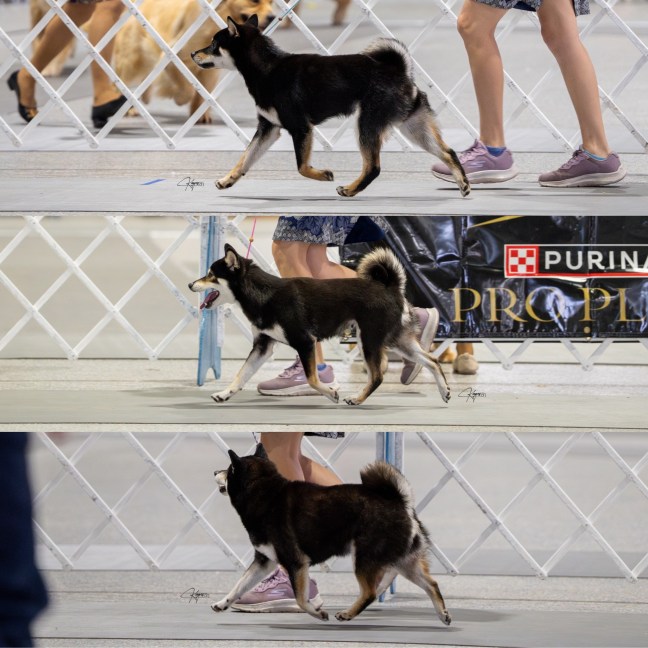

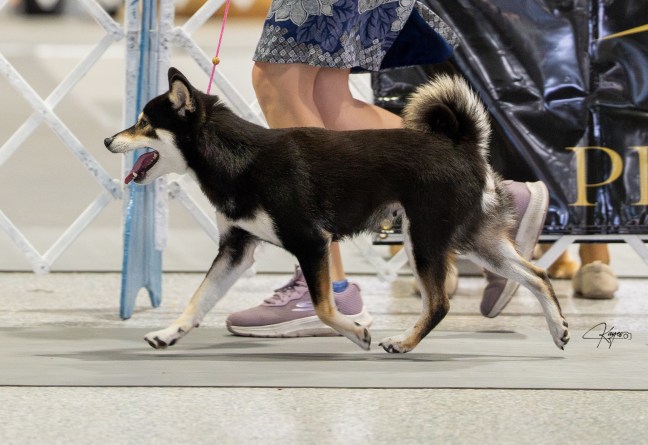

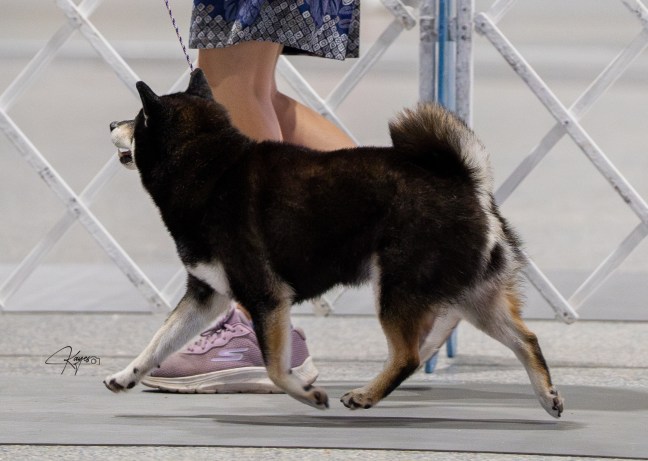


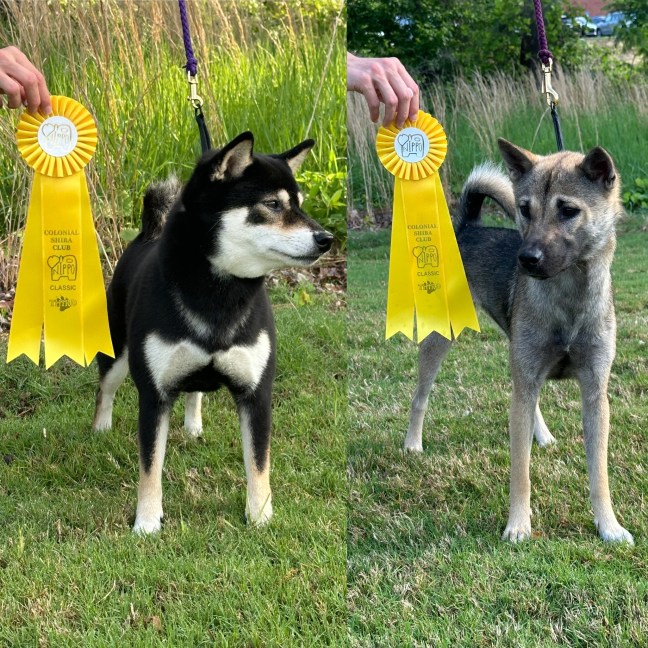


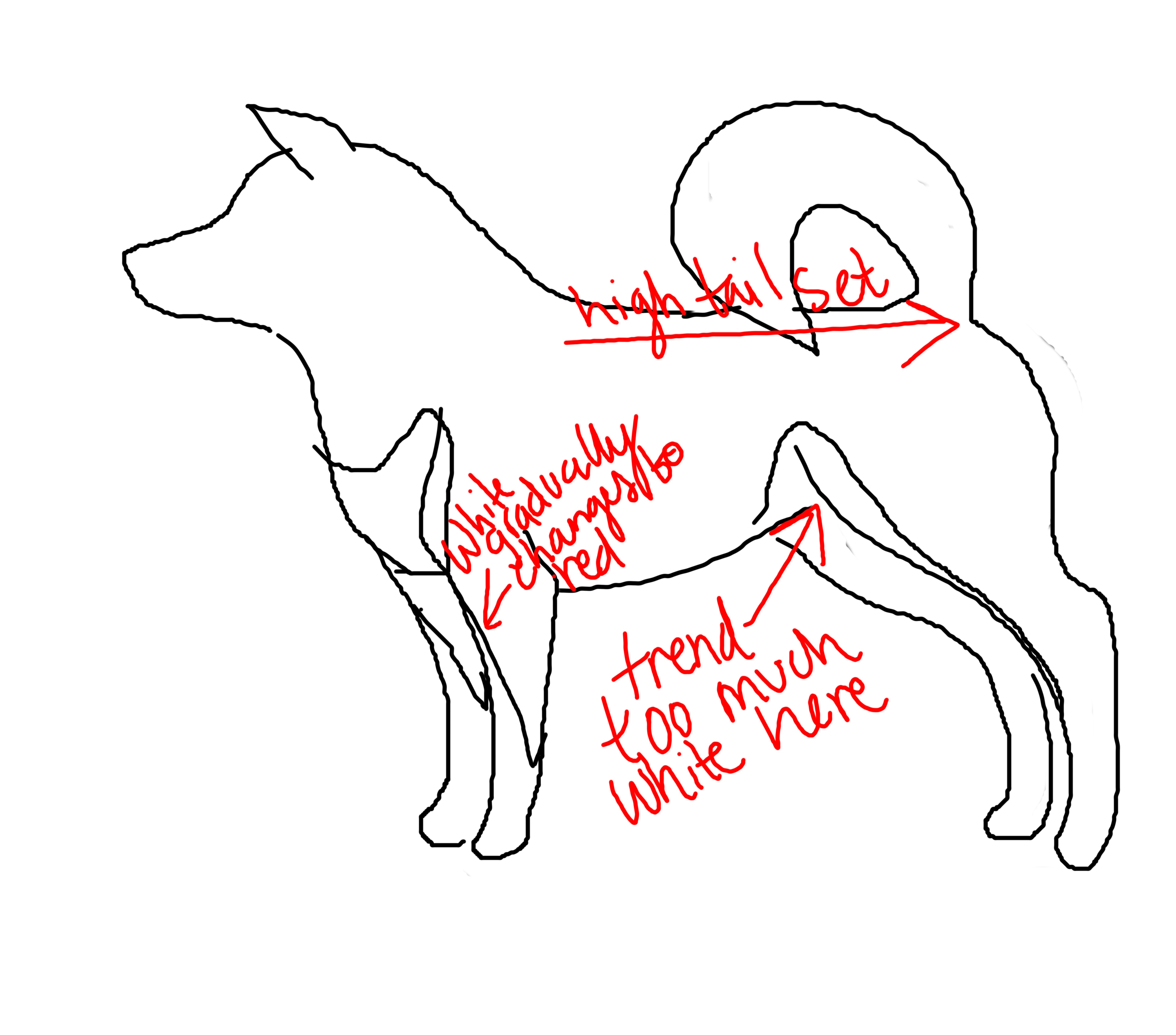

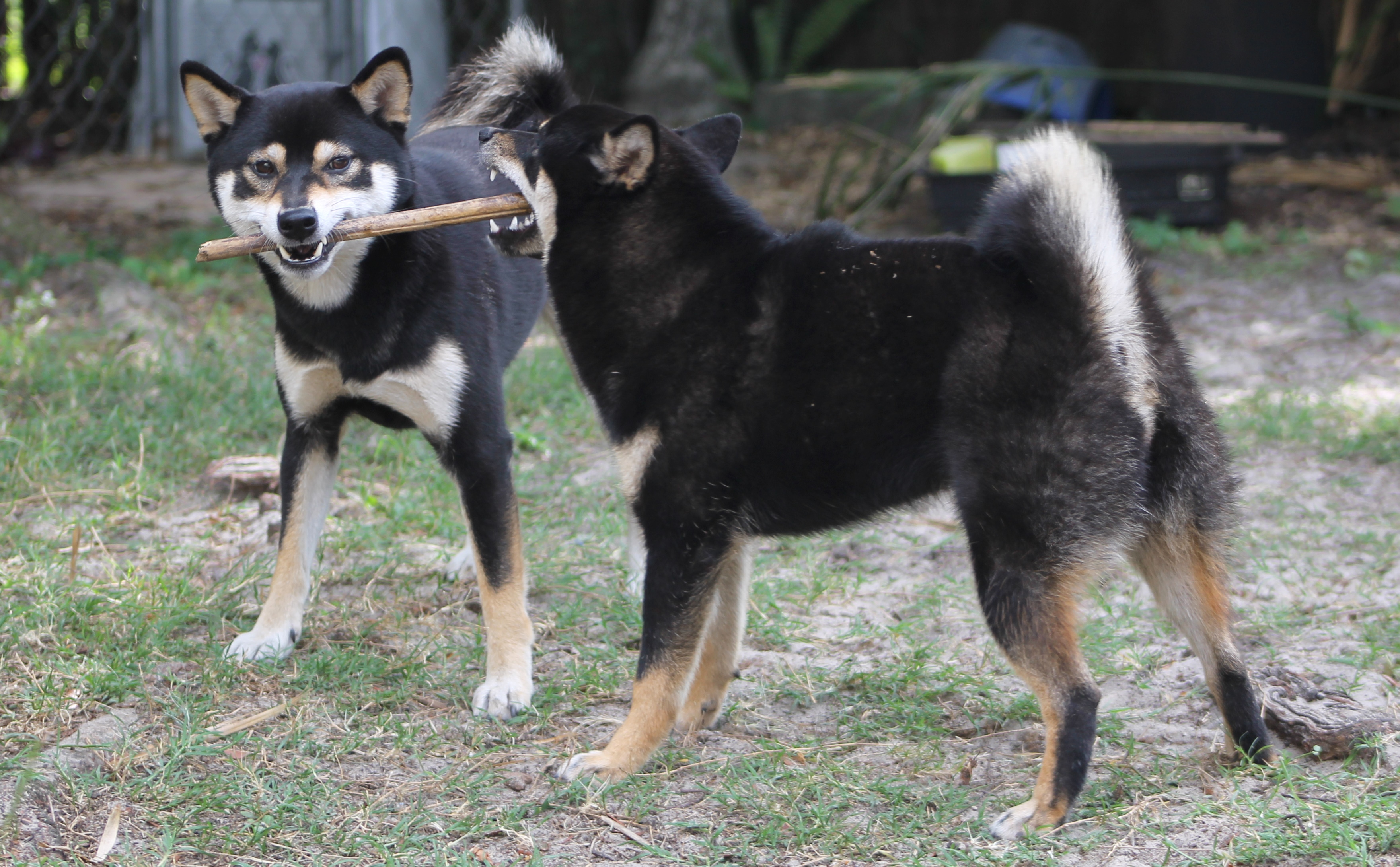
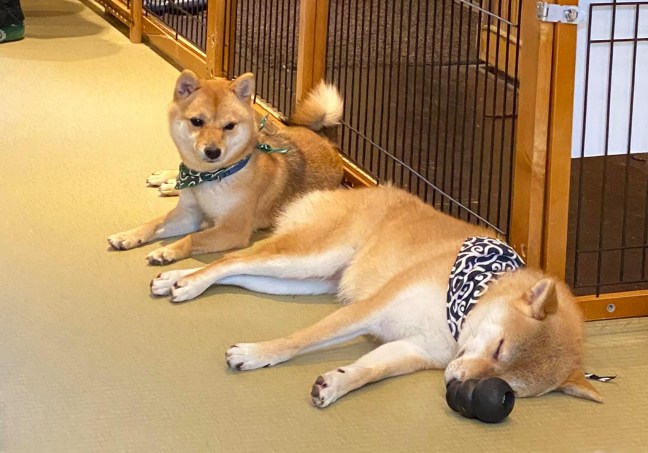




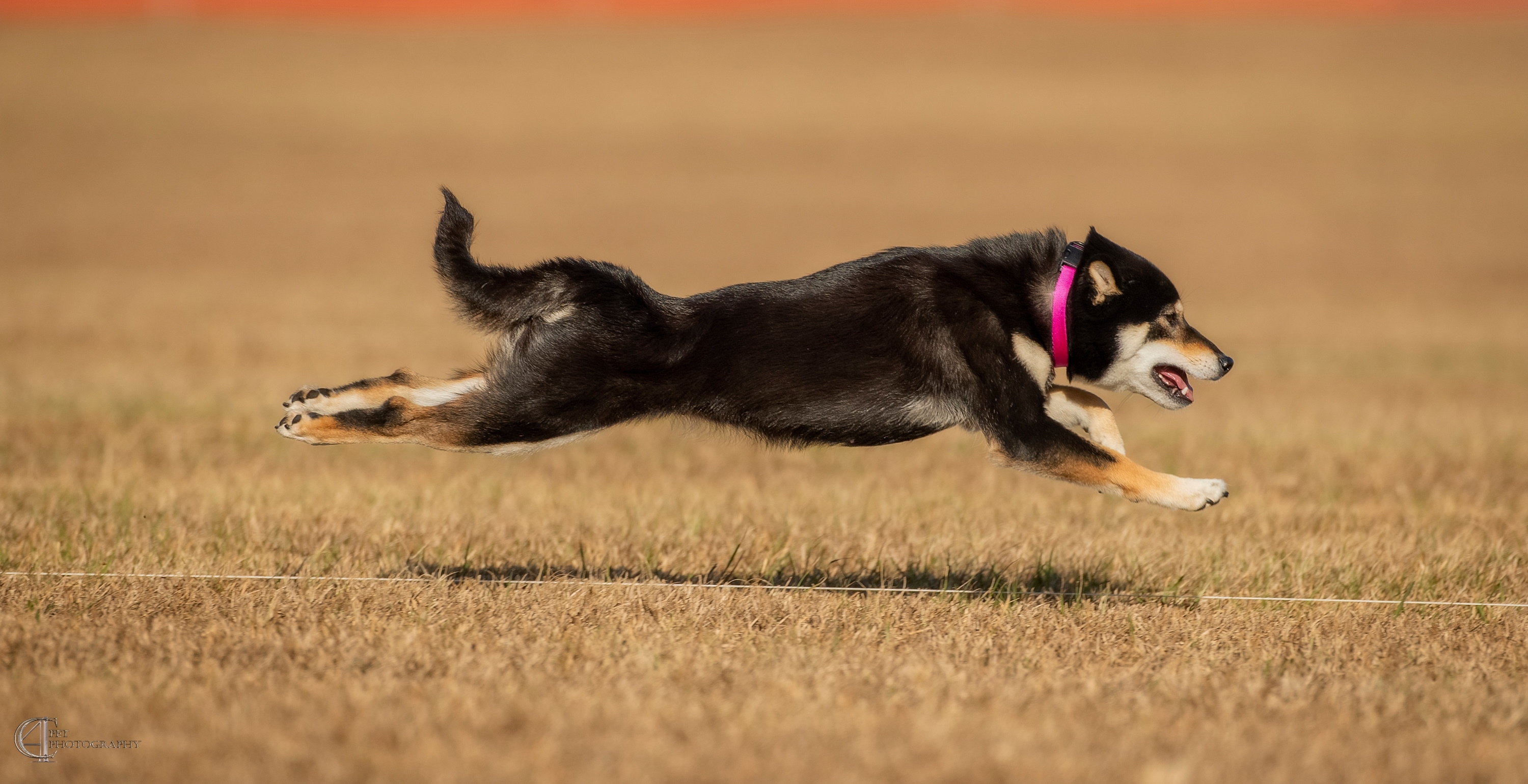


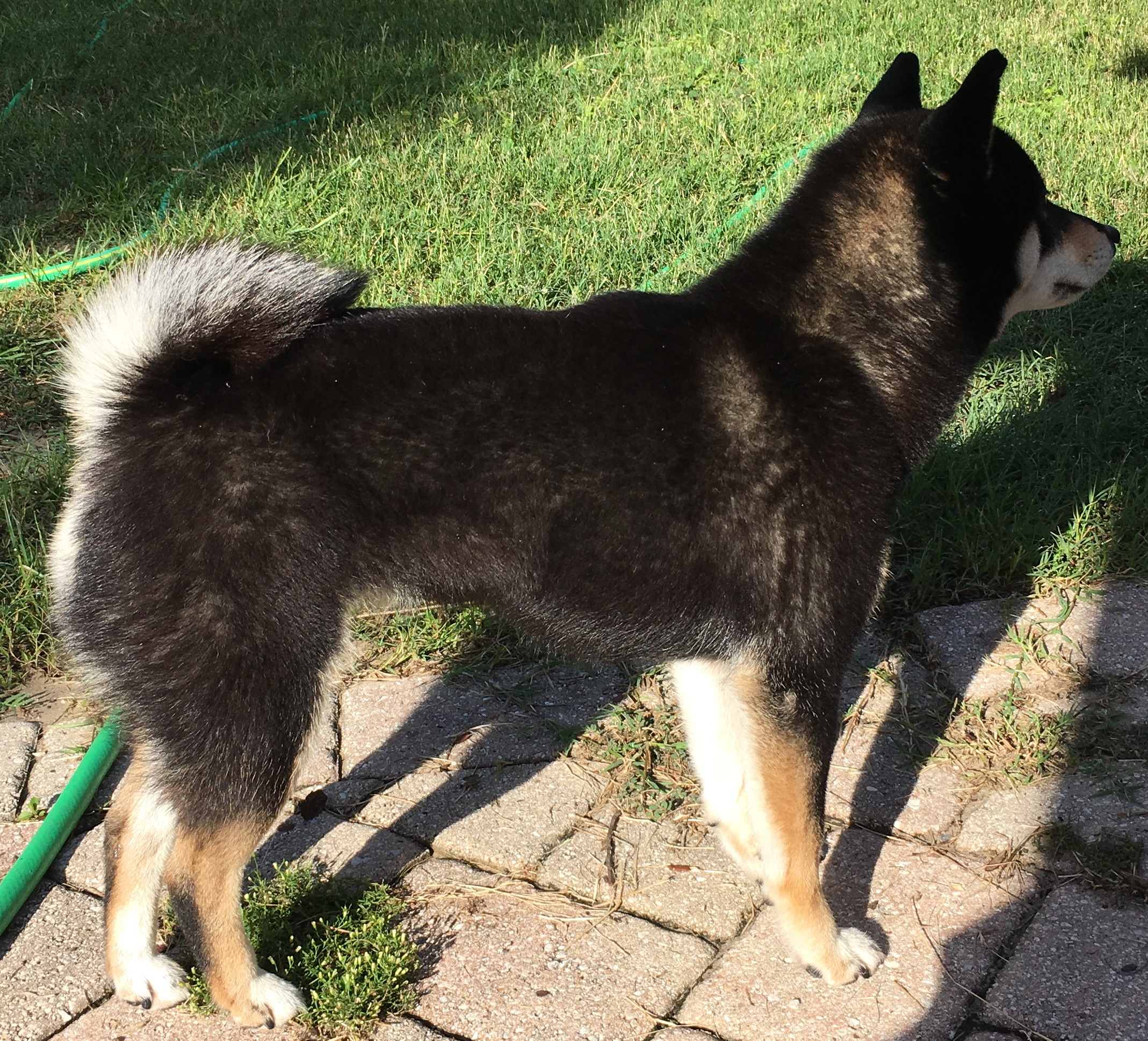
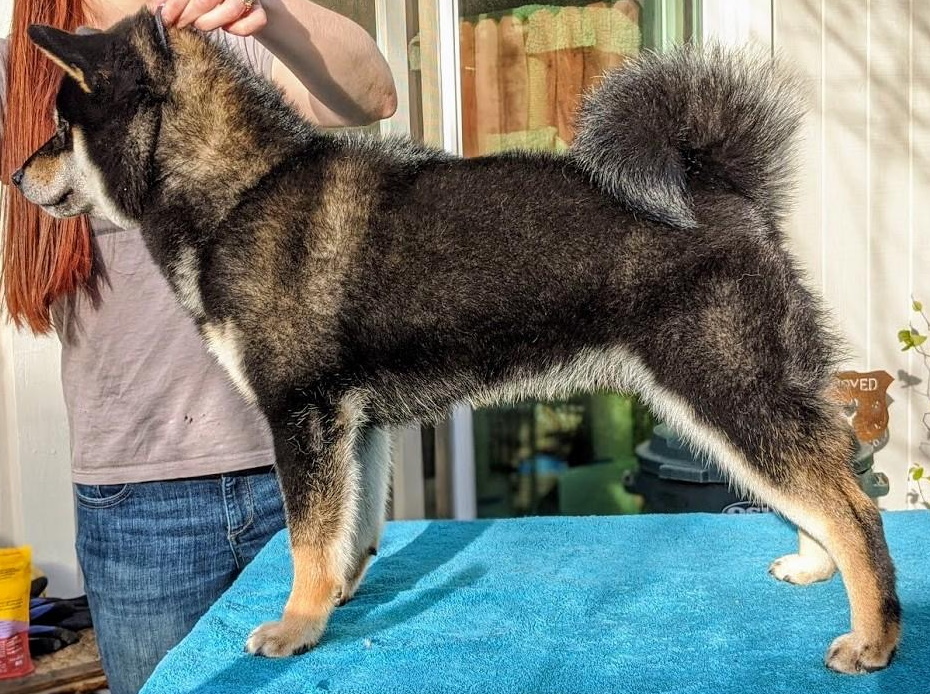


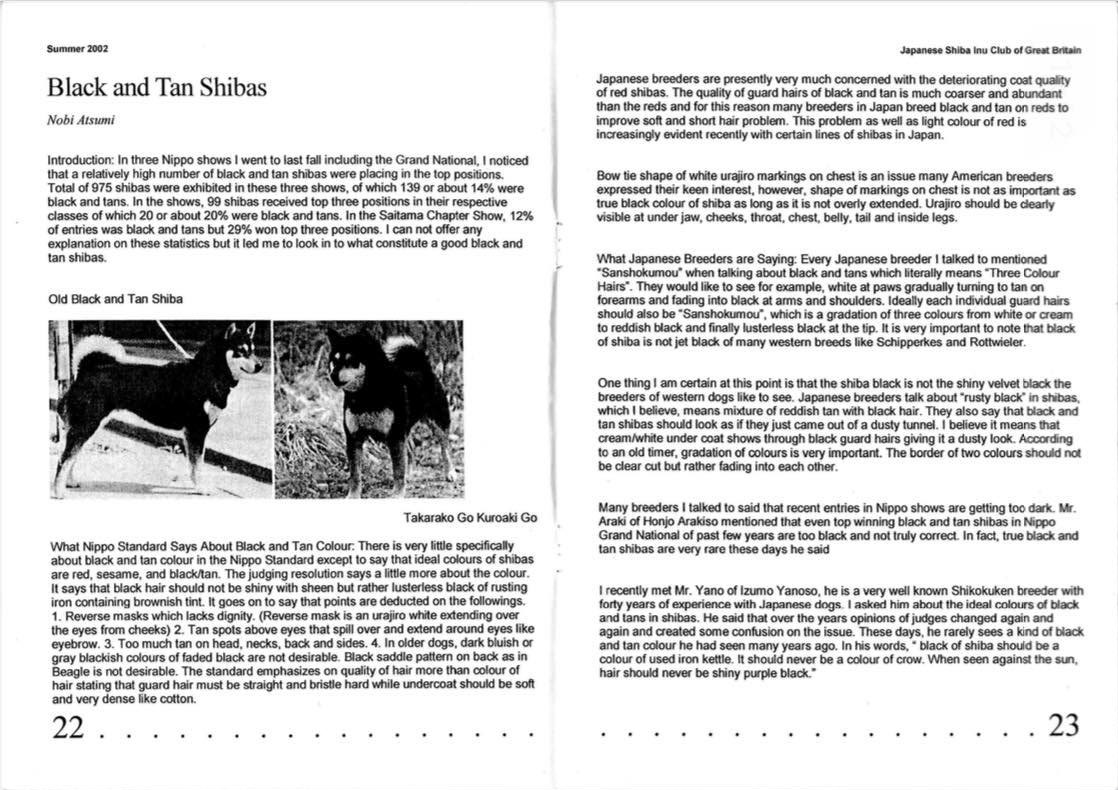
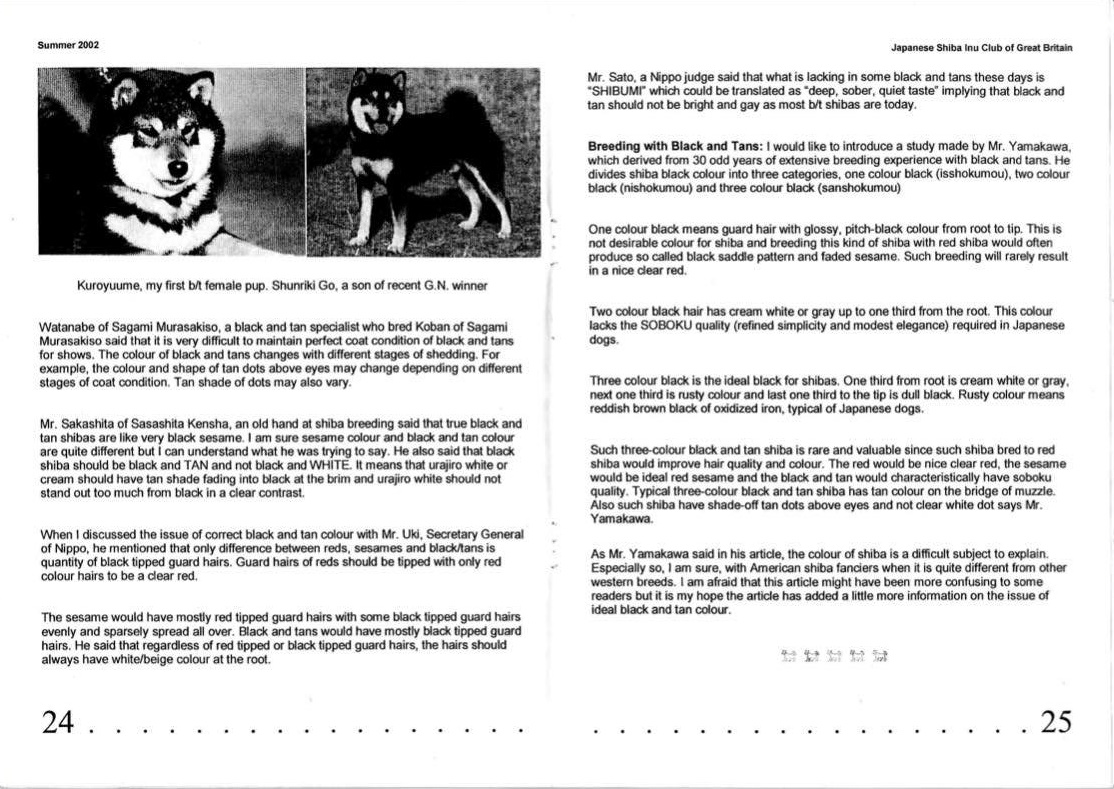
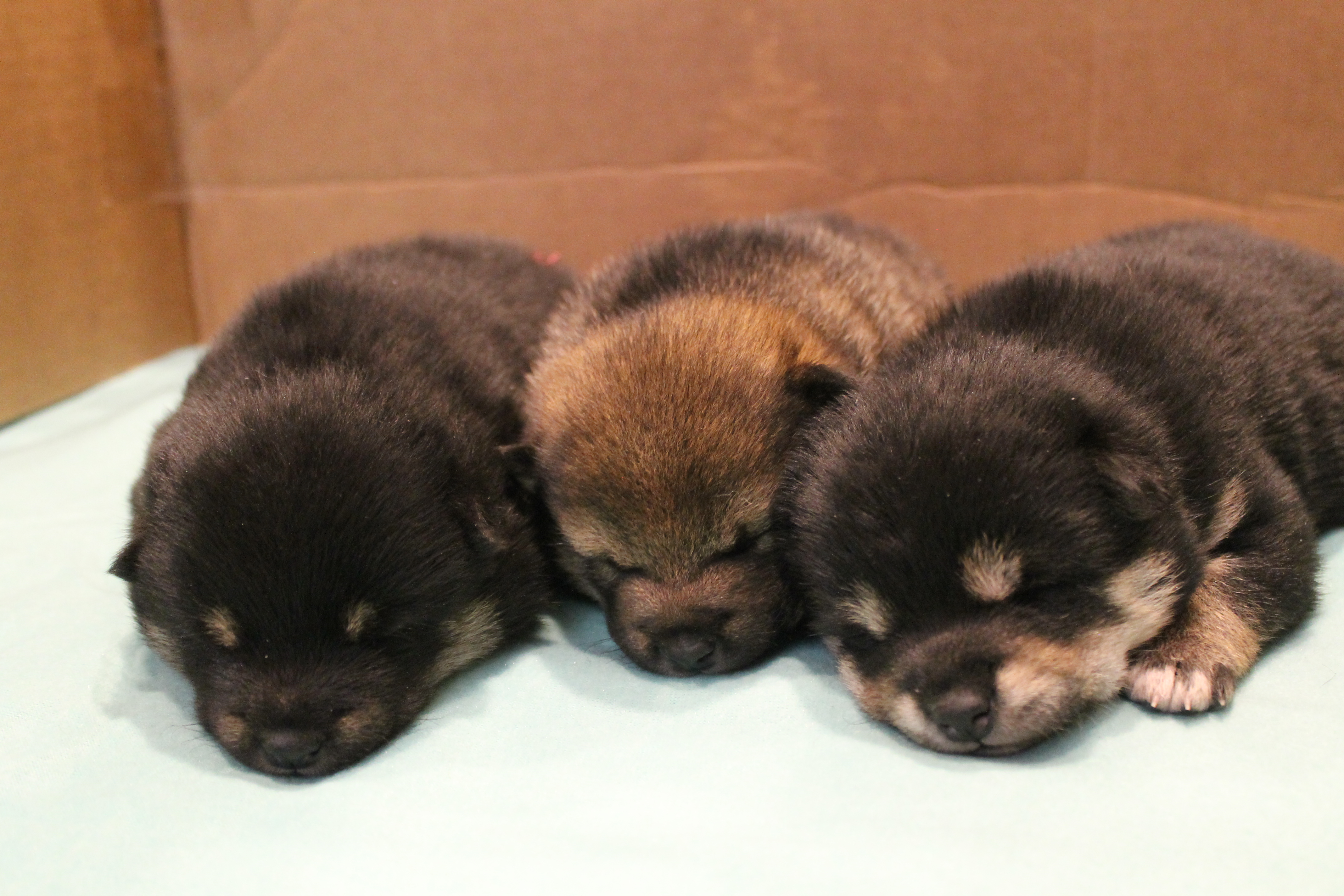
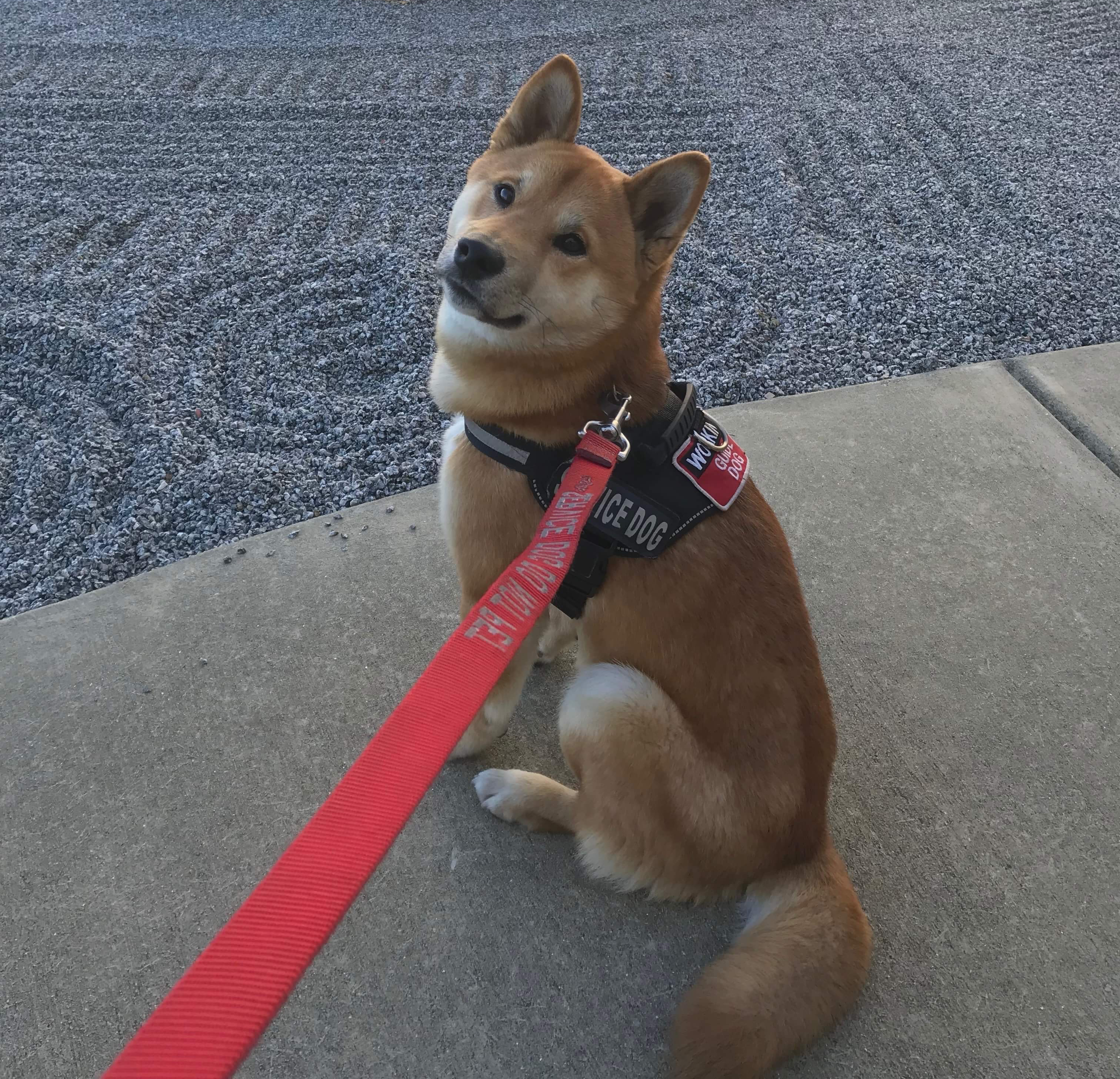
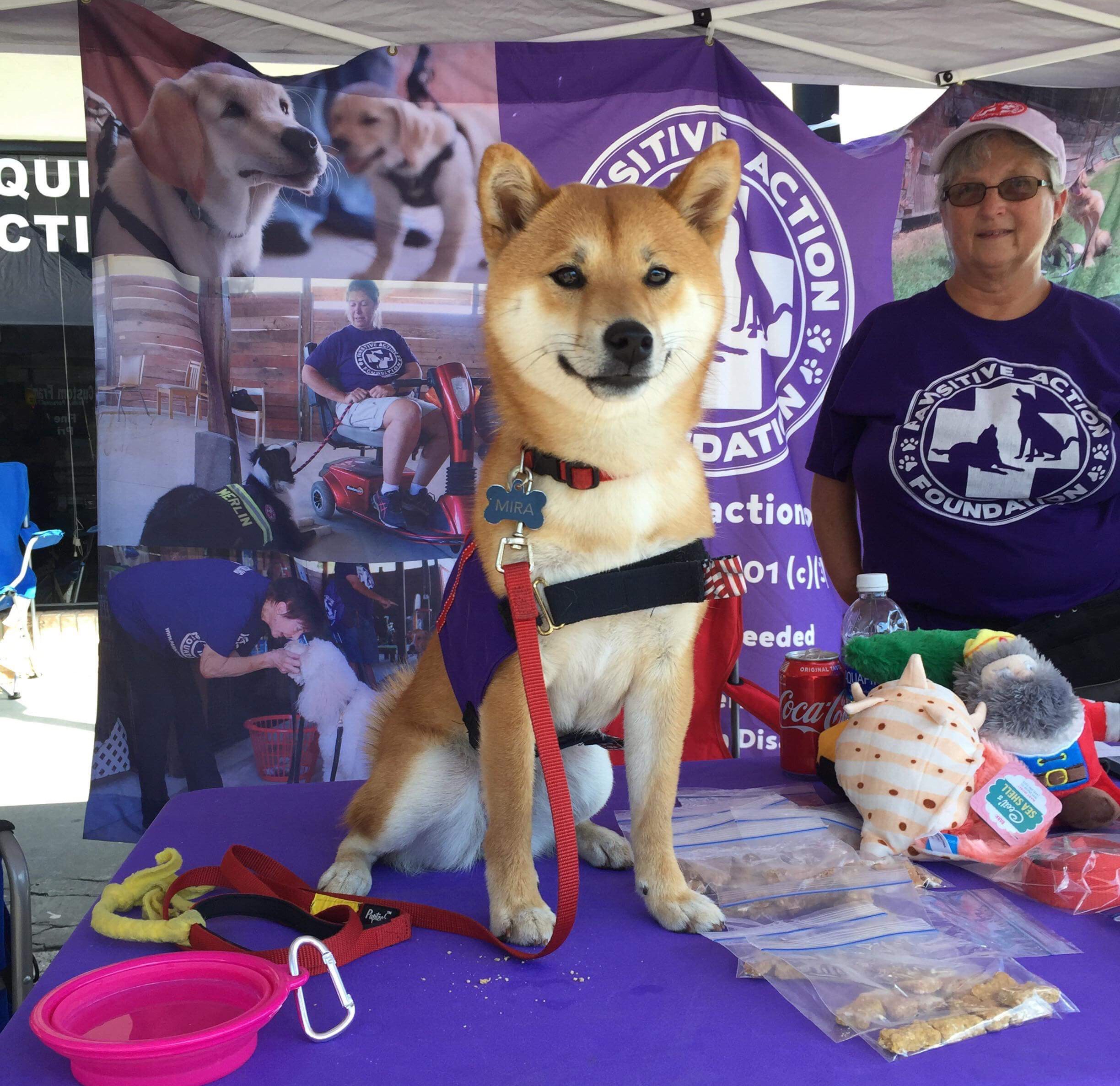
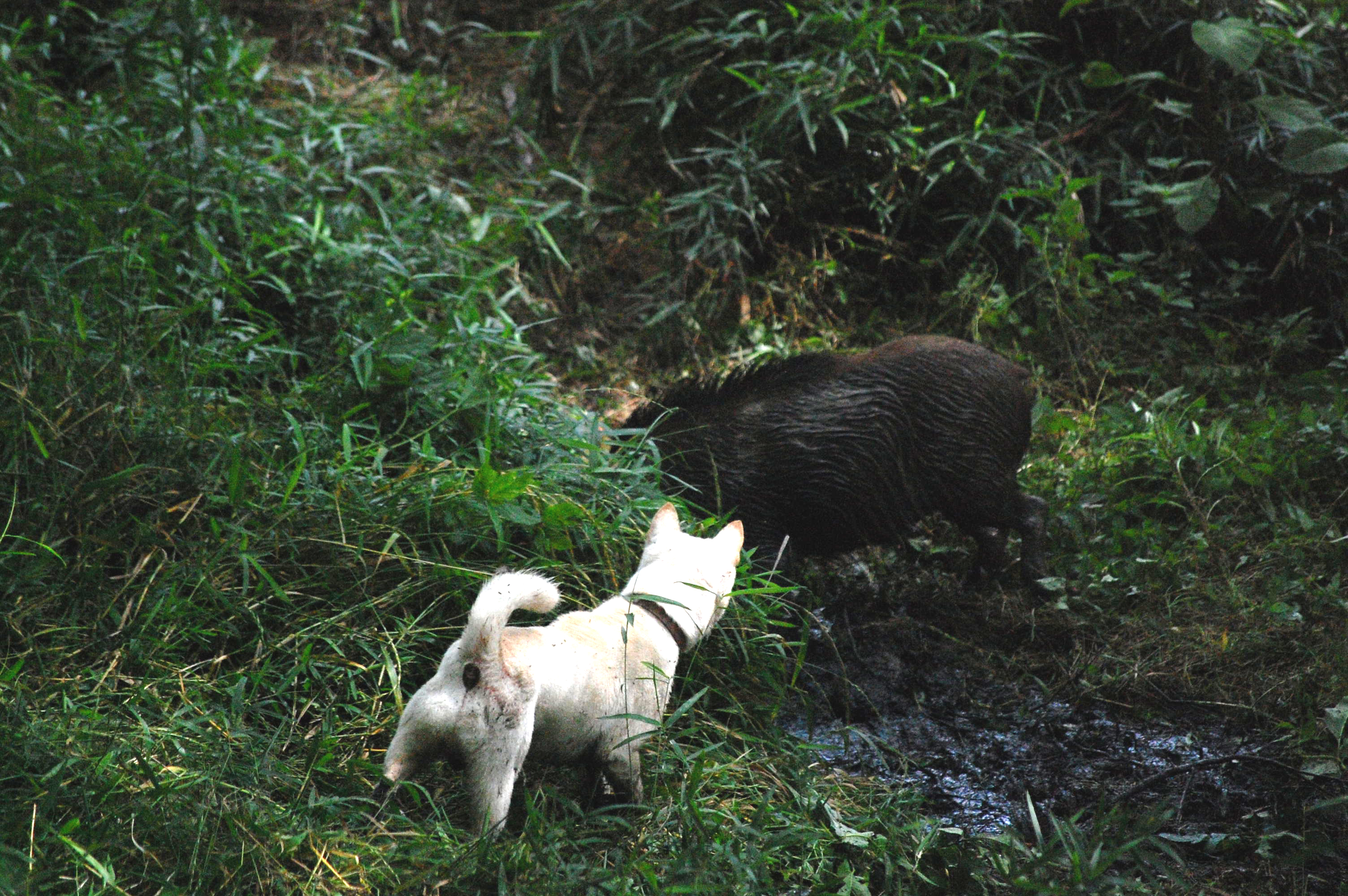

 Boomlay Shiba Inu