

Ok, I’ll admit, I was never really one to pay close attention to the toes on a Shiba before. Toes are kinda easy to overlook – mainly the attention is ‘are the feet on a particular dog flat, or are they cat like?’ Hint: they’re supposed to be catlike.
For most people, they probably don’t care about their Shiba’s feet. They walk, run, and jump so they are fine and that’s about as far as the concern for feet goes. But what if I told you toes/feet are important to the original function of the Shiba.
The Shiba Inu, first and foremost was a hunting dog. This small hunter ran up and down uneven mountainous terrain searching for and flushing animals like rabbits and pheasants. Nihon Ken (Japanese dogs) needed a strong grip to be able to do their job successfully – remember back in the day a dog that couldn’t hunt successfully was not kept. The Nihonken Hozonkai’s (NIPPO) standard states that:
Forequarters: … The fore pastern has a moderate angle, and the toes form a tight grip.
Hindquarters: … Toes form a tight grip. Dew claws on the hind legs, which are commonly seen in the Kishu Ken, are removed when the dog is 2 to 3 days old.
The AKC standard for the Shiba Inu, which was taken from the NIPPO standard states this:
Forequarters: … Pasterns are slightly inclined. Removal of front dewclaws is optional. Feet are catlike with well-arched toes fitting tightly together. Pads are thick.
Hindquarters: …The hock joint is strong, turning neither in nor out. Upper thighs are long and the second thighs short but well developed. No dewclaws. Feet as in forequarters.
Seems pretty straightforward, correct? Well unfortunately I have noticed an alarming amount of Shiba being shown and bred with toe faults recently! The two major toe faults I have seen are short toes and rolled toes.
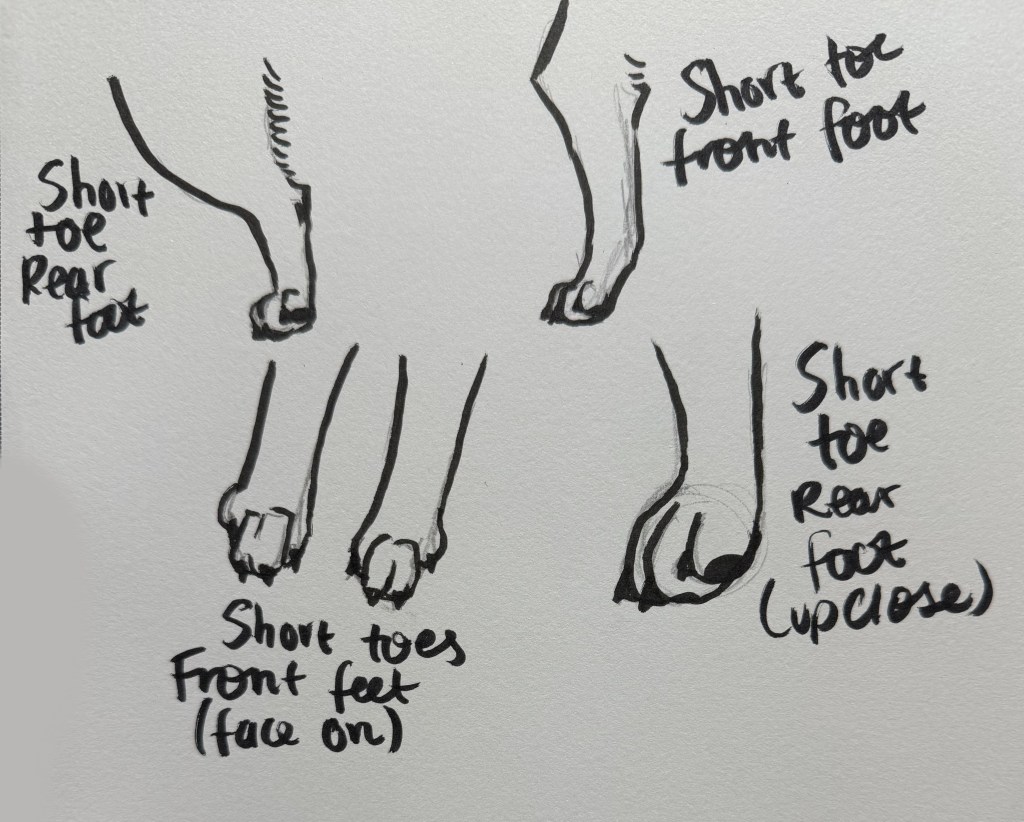
Short toes are pretty self-explanatory – the toe is short so it does not touch the ground. This inhibits the correct structure of the foot and would impact balance and movement in mountainous terrain.
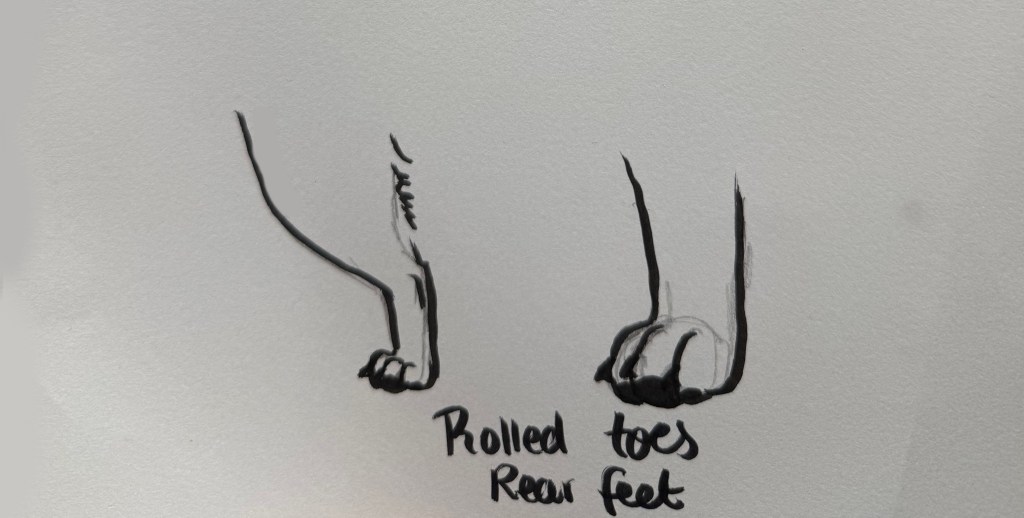
Rolled toes are something I never knew was a thing until a couple of years ago & I admit, never noticed until it was pointed out on MY OWN DOGS! Talk about embarrassing! But rolled toes are NOT short toes, but they are a structural fault where the dog’s toe pads are exposed when the dog is standing still due to internal structure of the foot. (https://showsightmagazine.com/dog-toes/)
Amazingly enough, neither NIPPO or AKC’s standard really mentions rolled or short toes as a serious fault – something I feel needs to be addressed as I’m seeing more Shiba out there with these faults. The standards simply state a strong grip & well arched toes fitting tightly together which yes, short toes and rolled toes fit neither of the categories but there are also not explicitly stated as a fault. I did email NIPPO asking about short toes & rolled toes for clarification, to make sure I get a better understanding of these faults and can help correctly preserve the breed. Here is NIPPO’s response with some slight editing for clarification.
In “Nihonken-standard”, both the forelegs and hind legs are described as having “firmly gripping toes.” Furthermore, the explanation of the Nihonken-standard states that both the forelegs and hind legs must have richly rounded toes, be moderately thick, and be tightly gripping without any gaps between the toes. “Tightly gripping” includes the posture of standing firmly on the ground.
Therefore, forelegs with the claws positioned too high or with the toes raised so the paw pads are visible are undesirable and may be considered defects depending on the degree. Such dogs generally have toes that are small in proportion to their body size, creating an unbalanced appearance.
In regard to short front toes: insufficient rounding of the forelegs, resulting in a lack of tight grip.
In regard to rear rolled toes: the outer toe significantly raised, which falls under the category of “congenital malformation,” and this condition will be judged and evaluated by the judges.
In regard to short hind toes: small toes in proportion to the body, resulting in a posture that does not reflect a strong, firm stance on the ground.
So naturally my next email correspondence was asking if one fault is considered more serious than another. Nippo’s answer actually surprised me.
“There is no difference between the short toes and rolled toes’ fault. Both faults are of equal problem.”
So, with this in mind, we as breeders need to pay more attention to the structure of our dogs’ feet. I know it is one of the easier things to overlook and it really is hard to balance good type, structure, temperament, and coat color. But I feel it is an important aspect of not only honoring the premise of the creation of the breed, but also to make sure that future generations are structurally sound.
NIPPO did leave me with these words of wisdom, which did make me feel a bit better about my rolled-toed dogs:
“There is no perfect Japanese dog in every way. However, we must strive for highly refined Japanese dogs (both in terms of temperament and appearance), give excellent evaluations to such dogs, and carry out preservation activities to pass them on to future generations.”

