I have had the incredible honor of meeting two very special women who have service dog Shiba Inus. I’ve been fascinated with the fact they have reliably trained their Shibas to be service dogs, a breed that is often considered too stubborn to train reliably! I kindly asked both of them to answer some question I thought of to give the Shiba Inu fanciers insight into how they’ve trained their service Shibas. To keep anonymity, I’ll use their initials instead of their full names. I was also given the amazing opportunity to interview the facility owner who helped train Mira.
RW owns Mira and CH owns Chiyo
• What was the biggest training struggle you faced when preparing your Shiba to become a service dog?
CH:There were none until recently! As a puppy, Chiyo could easily ignore other dogs lunging and barking at him in public. The challenge that we are facing is now that he’s maturing, he wants to play with these other dogs. We’re training hard to teach him that he has to ignore them like boring pieces of furniture. He’s slowly getting better considering we’re fighting Mother Nature and his instincts. But I know we will get through this passing “teenage” phase with persistence and high value treats! He’s a smart boy.
RW:Honestly, the biggest struggle I faced was myself. Mira was the first dog I’ve ever owned, so I doubted my ability to raise and train her properly. Nor was I sure how to cope with certain kinds of attention from others once Mira became a full access service dog.
A little over a year prior to getting Mira, I confided in my parents that I was struggling with PTSD. I told them that my psychologist said that I should consider a service dog, and they were incredibly supportive. After looking at different breeds and options for a year, I finally met my breeder at a show. Soon after, I put down a deposit on a puppy. At this time, only my parents and my aunt (who raises Canine Companions for Independence [CCI] puppies) knew that I hoped to make Mira a service dog.
There was definitely some internal conflict before I picked her up. I looked forward to finally having something that could help me with my PTSD. At the same time, doing so would make my struggles more public once Mira and I became a service dog team. Almost no one in my life, friends or family, knew about my disability, and I didn’t want to disclose this information until Mira actually became full access.
Again, Mira would be the first dog I ever owned, so I feared ‘ruining her’ through poor training. Fortunately, I had (and still have) a good network of supportive dog people: my aunt, who raises CCI puppies; my many friends who show their dogs in conformation; and everyone at the Pawsitive Action Foundation (PAF), where I trained Mira.
Happily, Mira swept away my anxiety a few days after coming home with me. My fears faded as we bonded. Training, while time-consuming and sometimes exhausting, was incredibly rewarding for both of us. She was a really easy puppy and I was surprised at how adapting to her training schedule helped me. There have been times when my PTSD made it impossible for me to maintain a normal schedule, due to panic attacks and fear of the same. However, with the responsibility of taking care of Mira, I found that I was better able to take care of myself. This meant that I could focus on raising and training her to the best of my ability.
This was the beginning of a tremendously positive change in my life. For the past six years, I had been unable to find the strength that I needed to take care of myself for my own sake, but I was able to find it for hers.
When Mira became a full access service dog with PAF, I was faced with a new conflict. Up until this point, I had kept my struggles with PTSD private. Having a service dog is like wearing a giant neon sign saying ‘there’s something wrong with me’ in public. Mira was helping me so much, but by acknowledging how much she was helping me, it also meant I had to truly acknowledge, confront, and accept how much my trauma affected me as well. Any attention, positive or negative, was an uncomfortable reminder of this.
I began to worry that the attention brought about by having a service dog would create more stress, anxiety, and panic attacks in public than it would prevent. I am incredibly grateful that members of the PAF with their own PTSD dogs noticed and understood what I was going through. They helped guide me through these conflicting thoughts without judgment. While PTSD isn’t something that can be cured in a traditional sense, only managed, I was able to work though a lot during this transitional period, and continued to work as hard as I always had with Mira. With her help, I’ve been able to mitigate a lot of my PTSD symptoms, allowing me to find joy in things I had been unable to for years, such as shopping by myself or attending public events with large crowds. She’s allowed me to live my life without fear again.
• What company did you use to task train your Shiba? What made you decide to use that company?
CH: We used Canine Connection, a company that does all kinds of dog training, including a service dog training program. We chose them because the trainer, Chelsea, had experience with Shibas and could come to our home for lessons, which was something we needed because it made it so much easier with my disability. Once we had our initial evaluation with Chelsea and saw how she and Chiyo interacted, we knew she had a special touch with him!
RW:I trained Mira through the Pawsitive Action Foundation (PAF) led by Norma Ross. The PAF is a nonprofit organization that primarily helps veterans by providing them with highly trained assistance dogs. They also help the differently abled population. The PAF raises and trains Golden Retrievers, Labradors, Australian Shepherds, and Goldadores (all of which are health- and temperament-tested) to be placed as service dogs. Since 2008, the PAF has successfully placed 80% of the dogs from their training programs with clients in need. The remaining 20% who are not placed as fully certified assistance dogs have still gone on to serve as therapy dogs or companion animals.
I learned of the PAF through my mother, who took her rescue dog there for training, as well as one of my conformation friends who helped produce a litter of Australian Shepherds with Norma. My friend’s pick from the litter is currently a grand champion.
I contacted Norma about a month before I had even picked Mira up. I did this to see what kinds of training programs the PAF offered. At this point, I didn’t mention that I wanted to make her a service dog, I just asked about general training. Norma was incredibly excited to hear that I was getting a Shiba, and informed me she used to own Akitas, (including one from the same breeder as Mira), and that her dogs had achieved success in areas such as obedience, agility, and conformation. There was no judgment or skepticism about wanting to train a Shiba, only genuine enthusiasm, so I was completely sold on bringing Mira there.
I chose to join the PAF’s Owner Trained Program. Here, I completed Mira’s training by participating in their classes at least once a week, as well as receiving occasional private instruction with Norma. Mira and I did this until we accomplished our goals. Mira was too young (eight weeks) to start classes when I got her, but we were allowed us to sit in and observe classes for free until she was old enough to socialize. Once we began classes, Mira excelled and progressed with her obedience training quicker than I honestly anticipated. Whatever nervousness I had about training a dog was long-gone. Every week, I took what we learned in class and continued to practice and build upon it at home. I can’t begin to describe what a joy it was to literally pour blood, sweat, and tears into doing my best to raise Mira to become a mentally and emotionally sound Shiba. Our hard work since the beginning really paid off as she started to mature. The bond between us was incredible, and Mira was consistently a well-mannered dog who wanted to please. Because of how much she was already helping me, I finally built up the courage to ask Norma if she would qualify as a service dog with the PAF when she was around six months old.
Mira and I met the qualifications with the PAF, and from this point on I trained her as a PTSD service dog. There is no official service dog registration or certification under the American Disabilities Act (ADA). However, I chose the PAF because they have their own organizational requirements that an owner-trainer has to complete before their dog is considered a fully trained assistance dog. Their service dogs are held to very strict and high standards if they are to become full access. Their dogs are also highly respected in our local community. Mira was ‘in-training’ for a long time, and only became a full access PTSD service dog with the PAF after we attended public outing training classes, completed our AKC Canine Good Citizen, AKC Canine Good Citizen Advanced, AKC Urban CGC, and PAF’s Public Access Certification. Through this process we customized her training so that she would be able to help me mitigate my PTSD.
• What lead you to your decision to have a service Shiba? Where there any biases from the training company when you mentioned the breed?
CH:I decided on a Shiba because even though I had loved many breeds growing up, I had bonded very deeply with my neighbor’s Shiba Inu, Nikko, in a way that I hadn’t with any other dog before. I used to baby sit him when his owners went on vacation, and I absolutely loved his energy. I knew a Shiba was for me. Also, I knew I couldn’t handle a large breed. I needed a smaller dog, but one still tall enough to reach me for the retrieval tasks that I need. Then there’s also the fact that Shibas are a primitive breed, one that is known to be highly intelligent. I needed a dog that would be able to use its own decision making skills to help me in the event I could be unconscious. Shibas have that intelligence that separates them from the average dog. Our trainer had experience with Shibas as well, so she knew exactly what to expect from my little puppy and had no negative bias against his breed
RW:As I’m sure you can imagine, I took the question of what breed would best be best suited for me very seriously. Any breed can be a service dog, but there is a reason that Labrador Retrievers, Golden Retrievers, and crosses of the two breeds make up the majority of the service dog population in the United States. Both breeds are highly trainable, possess stable temperaments, and have the stamina to perform a wide variety of tasks in any environment (especially public areas where other breeds might tend towards being too shy or aggressive). I considered these breeds as options, but did not feel that they would fit my own personality, temperament, or lifestyle.
I continued to do research and considered my options for about a year, but deep down I think I knew that I had committed to getting a Shiba pretty early on. What attracted me the most toward the idea of a choosing a Shiba is that they are mostly a ‘one-person dog’, and they usually develop a fierce loyalty toward the person they have bonded with. It was pretty hard for me not to fall in love with the idea of an intelligent, confident but quiet, naturally clean, and athletic dog with energy levels similar to mine. One who would be loyal but not clingy once I earned their respect. Breed size was another large draw. I plan on returning to school in August to pursue a PhD, and a bigger breed simply wouldn’t be realistic with the associated lifestyle or housing. I made sure I also understood the potential negatives of owning a Shiba and prepared myself for how I would handle certain behaviors if I were to encounter them.
As mentioned earlier, I went to the PAF before I had even picked Mira up to see if I wanted to train with their organization. I was aware that there is a stigma about Shibas being ‘less trainable’ than other breeds, so I asked Norma her opinion on the subject. She did joke that problems can arise when people own dogs smarter than them, but believed that Shibas and other Inus are perfectly capable of successfully participating in any dog activity, and can excel when they have good communication and trust with their handler.
While I didn’t receive any negative bias from the PAF, I did receive plenty of (reasonable) warnings from knowledgeable friends against owing a Shiba as a first dog. I can’t imagine the reactions I would have gotten if I had told people I was getting one with the intention of making it a service dog. Fortunately, my gut instinct about my compatibility with the breed proved to be correct. I personally did not experience any major difficulties, Shiba-specific or otherwise, while raising and training Mira. She was as close to perfect as you can get with a puppy, and quickly matured into an incredible service dog. I don’t think my success with her is the result of simply getting lucky with a ‘good Shiba’. It’s because I picked the breed I knew I would connect and bond with best. This bond, combined with proper early socialization and thousands of hours of consistent professional training (which I will elaborate on below) has allowed Mira to excel in becoming the service dog I needed her to be. I also didn’t train or treat her differently than any other breed of dog at the PAF. Given how successful Mira and I are as a team, I would argue that with the right owner and training, Shibas might actually make better psychiatric service dogs than many other breeds due to how strongly bonded, trusting, and in-tune they are with their one handler.
• How does the general public react to your dog? Do you get the question “how did you train your Shiba?”
CH:Chiyo is always met with curiosity and enthusiasm from the public, whether he’s out working or just going for his morning stroll with me. I get stopped by loads of people asking me “what kind of dog is that?”, and of course “how did you get him trained?” I’m happy to answer everyone’s questions, so many people have never even heard of the breed when I tell them he’s a Shiba Inu. Even less people understand what it takes to train a service dog. It takes hundreds, if not thousands of hours for a service dog to be fully trained, which is something many people ask about him and I’m glad I’m able to educate them. Sometimes they are wondering if a service dog could be something that they need in their own lives. I feel it’s important to share Chiyo’s journey because it shows what service dogs, specifically service Shibas, can do to help people with disabilities.
RW:”Is that a fox? No? Well it looks like a fox! What kind of dog is it? Doge! SHIBA! It’s the dog from the internet!” In my personal experience the general public acts in one of two ways: curiosity about the breed or, if they’re familiar with Shibas, pure excitement.
Unfortunately, regardless of breed, a lot of people get uncontrollably excited to see dogs in public places. The most common reaction I get is simply people wanting to pet Mira. It’s up to each individual handler to decide how they want the general public to interact with their service dog. I personally don’t mind if people pet Mira as long as they ask politely first. If I agree to let someone pet Mira, I will give her the command ‘make a friend’, to let her know someone is about to approach and touch her. First, I make sure she is sitting. Then, I allow the person to approach her and pet her on the side or under her chin. I like structuring greetings with strangers because there are a lot more people than you would expect who try to run up and pet without asking.
I am very firm with telling people to stop, and that she’s working, if they’re trying to pet Mira without permission. I’m also very good at weaving her out of the way. When Mira is working in public, she is supposed to focus on me and ignore environmental distractions. However, to do that she needs to be able to trust me without worrying that anything too uncomfortable or stressful is going to happen to her, such as strangers startling her or touching her in inappropriate ways.
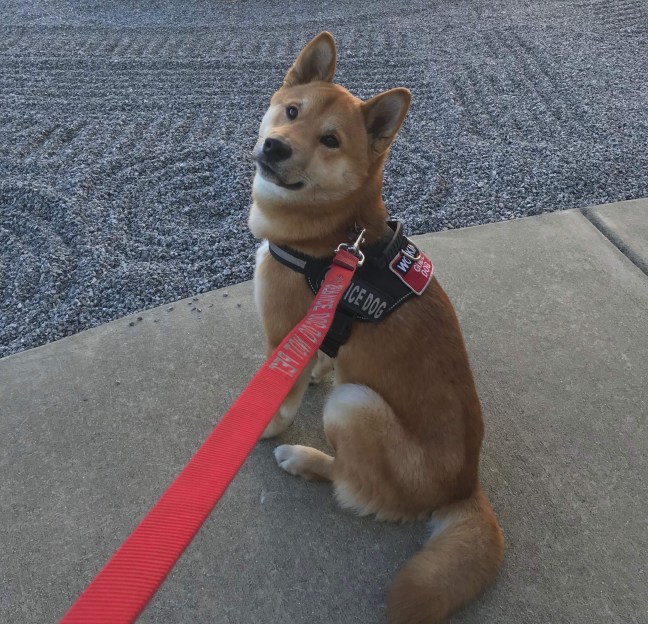
When Mira was still in training, she was so small that we had to use a recycled vest that originally belonged to a Labrador puppy. The only signage it had was a PAF logo. During this time, the general public was a lot more invasive. The public became less so once Mira started wearing her official full access vest. The vest displays ‘PAF PTSD Service Dog’ and her obedience titles. She is an unusual breed, and I don’t have any visible physical disabilities, so there have been members of the general public who have been accusatory and rude to me.
While a service dog is not legally required to have a vest or any signage about a person’s disability, the transparency has made everything so much easier for the both of us. I’ve found people are a lot more respectful about not trying to pet or distract Mira when she’s wearing her vest, and are significantly less disruptive overall while we’re working.
Finally, I don’t think I’ve ever been asked how I’ve trained Mira. I have, however, been stopped and told by many different individuals who are familiar with, or own Shibas, who feel the need to inform me that they’re un-trainable. I’ve learned not to let this negativity bother me and usually just smile and nod as Mira and I go about our business.
• Did your instructor have to alter any task training to fit your Shiba’s needs? (Training style, height restrictions, etc.)
CH:One thing that Chelsea did that was a customization to Chiyo’s training was teaching him his “perch” command. When Chiyo was still growing, he could retrieve items for me, but wasn’t tall enough to reach me yet. Chelsea taught him to jump up on his hind legs so that he could be tall enough to put objects in my hands. I’m on the short side and have long arms, so it was just the little boost he needed in the meantime until he grew to full size. Now that he’s an adult, he doesn’t always need to use his perch command to reach me, but it’s still a useful skill as well as a building block for other more complex tasks he now knows.
RW:At PAF, Mira was trained and held to the same standards as any other service dog in training there. We sometimes had to improvise smaller equipment for Mira since most things at PAF are sized for Labradors. The fact that she’s smaller never prevented her from participating in anything.
Mira progressed in her training around the same pace as the other dogs at PAF (and sometimes quicker), but there were a few occasions where Norma and I decided it would be best to alter her task training. Both were situations where we had to break down certain commands into more steps than another dog, such as a Labrador, might need. This was because Mira would sometimes over-think things. When we were working on recall, she was excellent at responding to ‘come’ unless I told her to ‘stay’ first. She was very proud of her ‘stay’ and would not budge even if I tried to call her over after. To help clear up the confusion between the two commands for her, I had to break up the command into ‘wait’ (a temporary stay where she is supposed to respond to commands after) and ‘stay’ (where she does not move at all).
The second time I had to break up commands was during retrieval training. For Mira, this was probably the task that took her the longest to learn. First, I had to teach her to target the color yellow (what I use for anything I want retrieved because it’s highly visible to dogs yellow-blue dichromatic color perception) and how to ‘hold’ objects in her mouth. Then I had to teach her she could move around while holding objects, something she seemed personally reluctant to do. Finally, I taught her how to pick up objects marked with yellow and bring them to me. I had to rework how I approached certain tasks a few times. However, once things click for Mira, she is incredibly consistent and happy to do her job in any environment.
• What was your Shiba’s motivation to work for you? How did you wean out treats?
CH:Chiyo naturally has a very high work drive, and he is extremely food motivated. I discovered this the day I brought him home at 8 weeks old. I made him do simple commands for spoonfuls of wet food, and I was so surprised that he came already knowing how to “sit.” Right then I knew I had a special one. He loves to work, craves mental stimulation, and constantly wants to learn more. I get tired before he does in our training sessions! But we don’t have to wean out treats, just like you wouldn’t wean an employee off pay checks. Though there are tasks he does perform without expecting compensation, rewards keep him interested and I believe in a fair trade. Chiyo will happily train all day long, especially when there’s something tasty to be earned. To him, working is his favorite game, and he always wins.
RW:Mira’s motivation to work for me ultimately comes down to the way I raised her and structured our relationship (and continue to do so) from the day I brought her home. I’ve always hand-fed her, and I believe this is critical. Hand-feeding established a very clear power dynamic between the two of us very early on. If Mira every needs anything, especially food or toys, she has to work for it. I’ve never let her run off with either to enjoy on her own terms. Of course, I make sure that this relationship is fun for her, with lots of positive reinforcement and praise. She’s definitely a dog that enjoys to solve problems and think things through in her own way. I’m convinced one of the reasons she’s done so well in obedience is because the way I’ve trained her leads her to believe that the behavior I require of her is her own idea.
I also made sure early on to teach her that I’m the most fun and interesting thing to be around. When she was a puppy until around six months old, our obedience training would be in very short segments multiple times a day. When we weren’t training, I would tie her on a six-foot lead clipped to my waist. This allowed her to be a puppy, while also teaching her that her place was to always be near me. I’ve heard Shibas are known for their cat-like independence at times, but the way I raised her never allowed Mira to be that aloof. I used the time we weren’t training for socialization. CCI has a fantastic socialization timeline for what potential service dog puppies should be exposed to, based on their age. At PAF and at home, I made sure I properly exposed Mira to as many sights, smells, sounds, trusted people and dogs in as enjoyable of a manner as I could.
I’ve never had a problem with Mira being willfully disobedient, stubborn, or destructive. If she engaged in behavior I didn’t want, I would correct her by firmly telling her ‘no’ and showing her what I expected of her instead. If she listened, she would be rewarded, if she didn’t, I would crate and ignore her. I would come back and repeat until she understood the correct behavior I wanted from her. This never took very long, as Mira did not enjoy being ignored and not receiving any attention. The crate was boring, spending time with me was fun.
Once she was around six months old and understood all her basics, I began to wean her off treat rewards. I began by making treats rewards random. For example, if I asked her to sit, instead of rewarding her every single time, she would get one treat for every three successful attempts. Mira responded really well to randomization. She didn’t seem to get frustrated and I think it became a fun mental game for her. Soon, I was able to spread out treat rewards even further, and today she consistently listens without any treats, just praise. Spending so much time and effort teaching Mira to explore the world with manners and confidence created trust and a special bond between us. Ultimately, this bond is why Mira is motivated to work for me and has lead to where we are today. Treats, praise, and consistently firm but fair training simply laid the foundation.
• Was there any specific method you used or the breeder used for picking a Shiba for you? (Genetics, temperament, etc.)
CH:I didn’t know it, but I was given pick of the litter. His breeder jokes with me about how she wishes she had kept him for herself! Chiyo was specially picked for me when I explained to the breeder what I was looking for and that the puppy was to go into training to become my service dog. I stressed the importance of a calm temperament and the smarts needed for the demanding job the baby would fill. She seemed pretty skeptical at the idea of a working Shiba, but said I could certainly try with the right puppy. And the right puppy he was indeed. When I asked the breeder what made her pick this baby for me out of all the others, she said he was the most “personable”, and that she could tell even at those stages of infancy that he was different than any other puppy she ever had.
RW:When I put down my deposit with the breeder, I made it very clear that I would prefer a girl. I also wanted the most even-tempered puppy in the litter. My breeder was very honest with me about what was available when some litters were born, and they selected a puppy for me based on my preferences. I don’t know if there was any specific method they used to pick a puppy, but I highly respect them for doing their best to meet my needs. Everything was very transparent, I was able to meet Mira’s parents and see how she was raised before coming home with me. I do believe the way Mira was raised with her breeder as a puppy has contributed to her mental soundness as an adult.
• What do you feel makes a dog service dog material?
CH:There are so many important qualities that go into the making of a service animal, and in my experience, among the most important is the dog’s temperament. Besides willingness, a dog in training needs to be able to keep calm and focused in any and all situations. Loud crashes and bangs, large crowds, long hours, food everywhere, and people of all ages trying to grab at you because you’re a cute dog out of context are just some of the things you’ll need to tolerate if you’re a prospective working animal. Many dogs can be taught to fetch, but not many can be taught to like living their lives in public. That’s why desensitization is vital when beginning with a puppy, and it’s a lot easier when that puppy has the right temperament as a foundation.
Next to that, I’d say trainability. You need a dog that enjoys the work, can pick up quickly, and that wants to learn. When you find what motivates your dog, there’s no limit to what you can accomplish. Chiyo still surprises me every day, and it’s just a joy to work with him. You can see how much he adores his job, it gives him such a sense of purpose, and he knows how needed and appreciated he is. I thank him every day for his service.
RW:According to the ADA a service dog is defined as:
”… any dog that is individually trained to do work or perform tasks for the benefit of an individual with a disability, including a physical, sensory, psychiatric, intellectual, or other mental disability. The work or tasks performed by a service animal must be directly related to the handler’s disability. Examples of such work or tasks include guiding people who are blind, alerting people who are deaf, pulling a wheelchair, alerting and protecting a person who is having a seizure, reminding a person with mental illness to take prescribed medications, calming a person with Post Traumatic Stress Disorder (PTSD) during an anxiety attack, or performing other duties. Service animals are working animals, not pets. The work or task a dog has been trained to provide must be directly related to the person’s disability. Dogs whose sole function is to provide comfort or emotional support do not qualify as service animals under the ADA.”
Under the ADA, State and local governments, businesses, and nonprofit organizations that serve the public must generally allow service animals to accompany people with disabilities in all areas of a facility that is open to the public.
The best service dogs are those with an even temperament, who are able to perform specific commands, and provide calm, reliable assistance after receiving years of expert training. I do not believe a dog should qualify as a service dog if they are: overly friendly or fearful; easily stressed out by crowded places; inappropriately reactive to other dogs; or cannot be controlled by their handler and consistently behave in unacceptable ways such as barking, having accidents, eating food, or disturbing other people. As I stated previously, it is undeniable that there are certain breeds such as Labrador Retrievers, Golden Retrievers, and crosses of the two that naturally excel at service dog work compared to others. However, any breed is capable of becoming a service dog if they are able to meet the rigorous standards to which a service dog must be held, as Mira and I love demonstrating.
While this is another topic in its own right, it is clear that across the country, more and more people are taking advantage of the ADA in order to have the convenience of taking their pets out shopping, to local businesses and to restaurants. Many people with disabilities who use service dogs have faced increased discrimination from businesses owners and other patrons, due to prior bad experiences with fraudulent service dogs. It is extremely frustrating to learn about people taking advantage of the ADA and passing off their pets as fraudulent service dogs. I don’t think there is a clear solution to this complicated and nuanced dilemma. However, I would strongly support better legislation that makes misrepresenting an assistance dog a punishable offense, as well as requiring proof of basic obedience training such as minimally acquiring a CGC before allowing a dog to become full access. The best I can do is to lead by example when Mira and I are working. Every time I go out in public, my goals are to show what standards a legitimate service dog is held to, and to demonstrate how a highly skilled service dog can enhance a disabled individual’s independence.
• Do you have an advice for people who want to task train their Shibas?
CH:I meet lots of owners who want to know how to get started with task training their Shibas! I’ve been able to help many families online by giving training advice and making little tutorial videos with Chiyo demonstrating how to teach new commands- from retrieving medications to getting your dog to use a litter box. For those who are just starting out I tell them first it’s helpful to have a private trainer do an evaluation to see if their dog has the right capabilities to suit the needs of the handler. Decide if you want to have a professional to help you with training, or if you’re experienced in dog training already, you can go the route of owner training. Next is to find out what motivates their dog. It could be a toy, it could be food, it could be scratches behind the ear, or even praise. Once you know what dogs want, you can get them to do something you want. With patience, repetition, and lots of love behind everything you do, you’ll be on your way to a beautiful relationship with your Shiba. The deep bond between a service Shiba and their handler is unlike any other.
RW:I’m obviously not an expert dog trainer, and I can only speak from my personal experiences. Just like people, dogs are individuals, so what worked for Mira and I might not work for someone else. At the same time, if I had to give advice, I would say: don’t ask how to task train your Shiba. Instead, ask how to task train your dog. Mira happens to be a Shiba, but I’ve trained her with the same mentality I would have had with any other breed, as elaborated on in my previous responses. My other piece of advice for anyone wanting to task train their dog would be to set up a good foundation by hand-feeding them (yes, it is incredibly time-consuming and they may go on a hunger strike in the beginning if used to eating from a bowl, but it’s worth it). If you have your dogs focus while task training, and make it fun for them (while at the same time being firm, consistent, and patient) it should lead to success. Most importantly, if you’re having fun through the process and give your dog your heart, they will return that love tenfold by bonding with and trying to please you. Especially if your dog is a Shiba.
Training facility interview
I was able to interview Norma, the facility owner of the Pawsitve Action Foundation (pawsitiveaction.org). This foundation helps meet the needs of veterans and people in need of service dogs. Norma breeds and trains her own dogs, providing lifetime support to both the dogs and their owners. Norma pays special attention to her client’s needs and engages them throughout the training process. She provides clients with the ability to learn valuable handling and training skills, ensuring a successful relationship between dog and owner. Since 2008, PAF has successfully placed 80% of their dogs with clients in need.
One question I asked Norma was how much did she have to alter her training program to accommodate a Shiba? She explained she didn’t alter much. Her service dog training program was developed after years of working with multiple dog breeds, resulting in the ability to reliably train a variety of dogs with a variety of different personalities. With primitive breeds, such as Shibas, she strongly suggests starting training as early as possible.
Norma then leapt into some specific Shiba training advice for that works well for primitive dogs and, in this specific case Mira. A suggestion she offered, is having people teach their puppies to play more with toys, as it will help as a reward during training. Some dogs who aren’t taught toy drive will look at you like “you threw it, you go get it”! Working one on one with a puppy when they’re young will help create toy drive. Cat toys are a good start towards making a puppy more accepting of play, which in turn helps with creating motivation. Another suggestion given was playing ‘find it’ games. Hiding something then having the dog search for the hidden item helps engage the dog, helping prevent a split in human-dog interaction often seen in more primitive dogs.
All dogs are domesticated animals. However certain breeds, such as Labradors and Golden Retrievers, are more domesticated than others. The more heavily domesticated a breed is, the more juvenile puppy behavior they retain even as adults. Primitive breeds such as Shiba Inus grow more out of their juvenile stage and develop more adult dog behavior (resulting in a greater capacity for independent thinking). A goal for successful training therefore is to create a dependency (a puppy behavior) with these breeds, rather than foster independence.
One way to create this dependency is by hand feeding; this is not withholding food but rather making the dog work in order to be fed. Start with eye contact. Dogs who make eye contact will be fed. After this step, encourage the dog to move towards to you and give eye contact for food. Ultimately, this eye contact is teaching and retaining begging, a puppy behavior. Some dogs may offer eye contact reliably because they’re more ‘puppy-ish’, while more mature dogs will struggle because it is a perceived as a threat. But as owners, we need to train reliable eye contact for successful communication. Meaning we have to teach and reinforce begging and other puppy-ish behaviors to create dependency. After the basics, educational games allow the dog to interact and engage the owner, which is extremely important when training a Shiba to be a service dog. Mindless wandering creates independence!
With primitive breeds, focus on just a few repetitions at a time, or they’ll quickly get bored. During training you’ll want to have one good progression, then pause and give the dog a break. If you keep repeating the same thing over and over, the dog will become frustrated as they’ll wonder what they did wrong and why they aren’t able to progress.
In order to be successful while training a Shiba, it’s important to remember what the breed was originally bred to do.
It is well know Shibas were bred to hunt. They had to be smart and quick to survive their hunting adventures. They also didn’t have a lot of human direction when loose in the mountains, so independent thinking was required of the breed. This independent streak has been known to lead to training troubles, because Shibas question commands. You can’t fight with them, so a handler has to convince them that it was their idea to carry out a command. Let them to problem solve, if they do, they get. Allow them control the outcome of the exercise by complying, because in their mind, they’re controlling the situation. “If I sit, I get.” “If I heel, I get.”
For greater success, it helps to breakdown training to tiny pieces. Treat training like building blocks. Because Shibas are a naturally suspicious breed, you have to show them each advancement in the training is not so different, maybe just a tad but not enough where they wonder what’s going on or get frustrated with the change. Owners tend to get upset with the dog instead of properly evaluating the situation, resorting to the conclusion of “Oh they’re so stubborn.”
After sharing this insight, I asked Norma what the biggest struggle she faces with training (service dog or not) has been. She explained it isn’t finding the right motivation to get a dog to work with their handler, but rather the frustrating reality that some people aren’t willing to listen. They want to do everything their way, often with no experience, instead of finding a good instructor they can take their dog weekly or bi-weekly to. They allow the dog too much freedom, resulting in the unfortunately common situation of thinking their dog isn’t causing any problems until the dog reacts drastically in a situation it’s never been properly trained to handle (such as biting a strange guest in the house). People need to accept, understand, and respect their chosen breed. A Shiba is not, and will never behave in the same manner as a Lab, so a handler must work with the dog they chose in the most appropriate way with that breed.
The last question I asked Norma was what does she feel makes a dog service dog material? She stated she believes any breed is capable of becoming a service dog if they’re able to reliably provide specific care for their owners. She emphasized that genetics do play a significant role in determining behavior, and preferably one should go to a breeder who knows their bloodlines as well as what temperaments they produce. Norma considered low reactivity one of the most important behavioral traits when selecting a service dog prospect. A program she suggested using as a guideline was Sue Sternberg’s Asses-a-pet program (http://www.suesternberg.com/rvaa/assess_pet), which helps predict sociability and aggression in dogs.
I would like to give a huge thank you to Norma of Pawsitive Action, RW and CH for taking the time to answer my questions and giving me and the readers a little insight on services Shibas and the training they received.




 Boomlay Shiba Inu